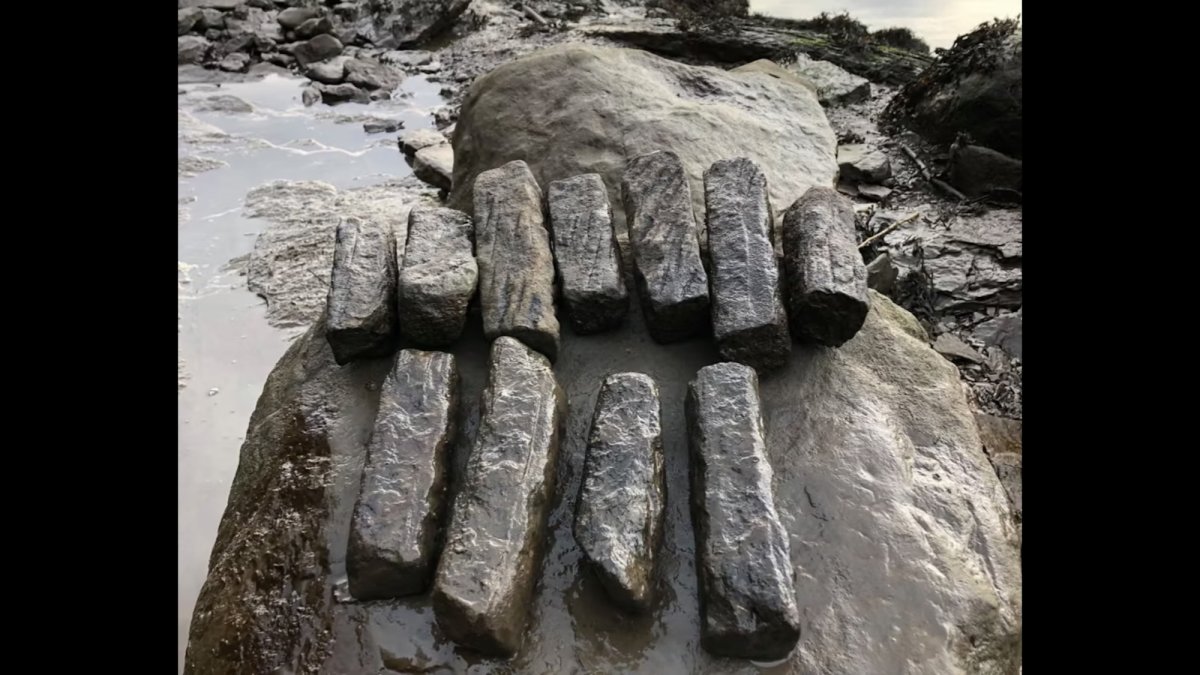
At the height of its power, the Roman Empire extended as far away as Britain. Rome didn’t view the region as remote or unimportant to its audacious goals, however. Based on a new trove of archaeological artifacts discovered in northeast England, Britain hosted critical sites that supplied the empire’s vast military complex.
Over six months in 2025, researchers from the United Kingdom’s Durham University excavated the new evidence on the banks of the River Wear not far from Newcastle, England. There, experts located over 800 whetstones—traditional tools used to hone blades and weaponry—the largest deposit of its kind in northwest Europe. Archaeologists then utilized Optically Stimulated Luminescence (OSL) to date the items. OSL is particularly helpful for dating quartz and other minerals that amass miniscule amounts of energy from sunlight.
After focusing heat or light on the material in a controlled environment, scientists can determine how long an item has remained buried in sediment. While the soil below the whetstones dated to 42–184 CE, samples taken from the tools trace back to 104–238 CE, when Romans occupied the island.
Additional nearby clues support the theory that the area functioned as a military manufacturing hub. Researchers noted a sandstone formation on the other side of the river—a likely sign Romans selected the location to quarry materials for their whetstones. Apart from the small tools, the team also excavated five stone anchors. These, coupled with another six anchors discovered along a neighboring location in 2022, suggest the waterway hosted vessels that carried sandstone across the river.
Why so many whetstones? The answer likely can be found in their overall condition. All of the artifacts displayed some form of damage, meaning artisans likely tossed them aside because they didn’t meet the Roman army’s required whetstone length requirements. According to Durham University, the military “was particular about the uniformity of its equipment.”
The archaeological discoveries here didn’t only date to ancient Roman occupation. Other finds within the sediment layers included both a stone and wooden jetty, chisels, a Tudor-era leather shoe, and even cannonballs and ammunition from the English Civil Wars of 1642 to 1651.

2025 PopSci Outdoor Gift Guide
Science,ArchaeologyAncient Rome,culture,News#ancient #Roman #blade #sharpeners #Britain1767989221