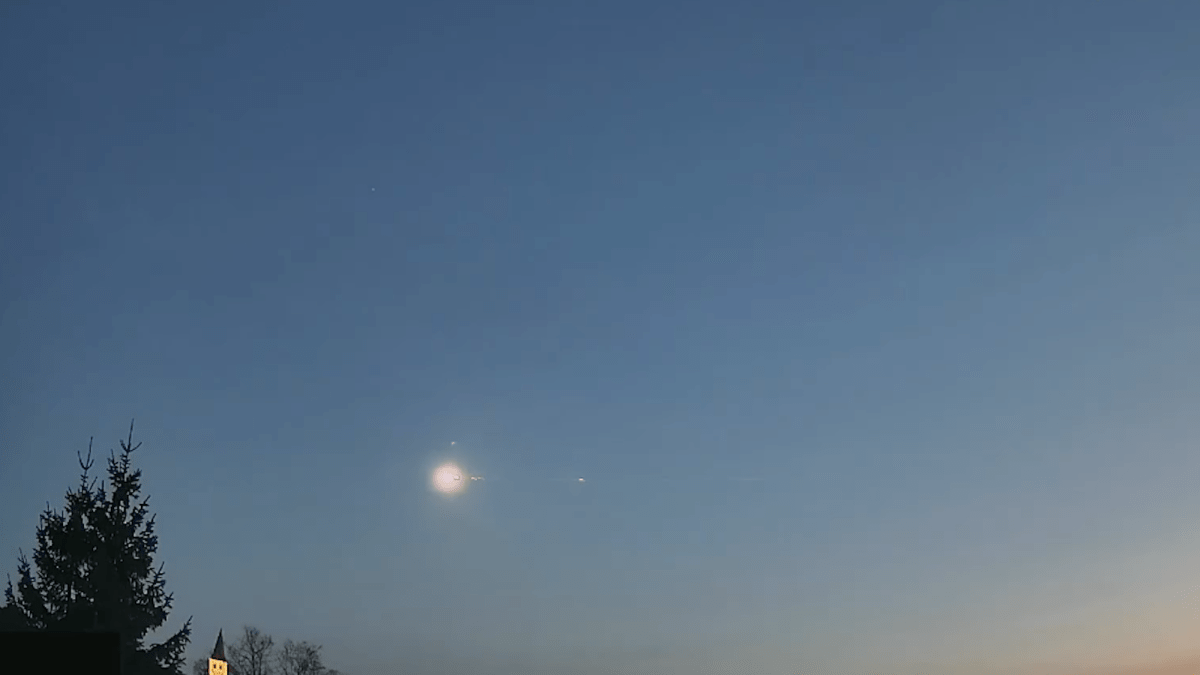
The European Space Agency (ESA) is investigating a bright fireball that lit up the early evening sky across at least five countries on March 8th. At around 5:55 p.m. local time, residents across Belgium, France, Germany, Luxembourg, and the Netherlands spotted a glowing object soaring across the sky for an estimated six seconds before disintegrating into multiple fragments. In the German town of Güls—around 50 miles west of Frankfurt—at least one house was damaged by debris .
Although more information is needed, the ESA’s Planetary Defense team believes the object was a meteor measuring at least a few feet in diameter. And while astronomers stressed there isn’t much to fear, there is no denying it: such events aren’t exactly rare.
“Objects in this size range strike Earth from once every few weeks to once every few years,” the ESA explained.

Fireball over Europe, 8 March 2026
The planet is bombarded by thousands of tiny space rocks every day, but most disintegrate before impact. Encounters with larger objects are inevitable, and even dramatic. In 2013, an asteroid the size of a six-story building crumbled about 15 miles above Russia, generating a shockwave equal to a 500-kiloton explosion and injuring around 1,600 residents. The most cataclysmic events—those that fundamentally alter Earth’s climate and ecosystems—are thankfully much rarer. For example, the last time an asteroid over six-miles-wide hit the planet (the one that killed the dinosaurs) was approximately 66 million years ago.
Unfortunately, it’s still extremely difficult to anticipate incoming meteors like the one likely responsible for the recent sightings in Europe. Astronomers have so far successfully anticipated incoming meteors only 11 times on record. Apart from their comparatively small size, it’s even more difficult to spot them whenever they reenter Earth’s atmosphere in a region experiencing daylight. Meanwhile, international agencies and governmental emergency response organizations are constantly attempting to boost their ability to coordinate and mitigate worst case scenarios. For its part, NASA hopes to launch its Near-Earth Object Surveyor no earlier than 2027. Once deployed, the infrared space telescope will scan the cosmos for any incoming visitors that may pose a threat to Earth’s inhabitants.

2025 PopSci Best of What’s New
Science,Deep Space,Solar System,SpaceAsteroids,News#meteor #soared #Europeand #possibly #hit #house1773155435