The discovery of a new magic mushroom species in Africa is forcing mycologists to take another look at the famous psychedelic fungi’s evolutionary history. According to a study published today in the journal Proceedings B of the Royal Society, both the popular Psilocybe cubensis and a newly described species shared a common ancestor roughly 1.5 million years ago—but not in the region of the world many assumed.
When you hear about “magic mushrooms,” it’s generally referring to P. cubensis. At moderate and high doses, the fungi cause sensory hallucinations and altered perceptions of time. Increasing evidence also indicates microdoses may have extremely beneficial therapeutic uses. While it thrives in tropical climates and famously prefers growing on cow dung, ecologists have long puzzled over how it spread across the Americas due to a very specific historical event. Cattle simply did not exist in that region of the world before European colonists brought it in the 16th century. Researchers have long assumed cows inadvertently brought P. cubensis into the Americas during the 1500s.
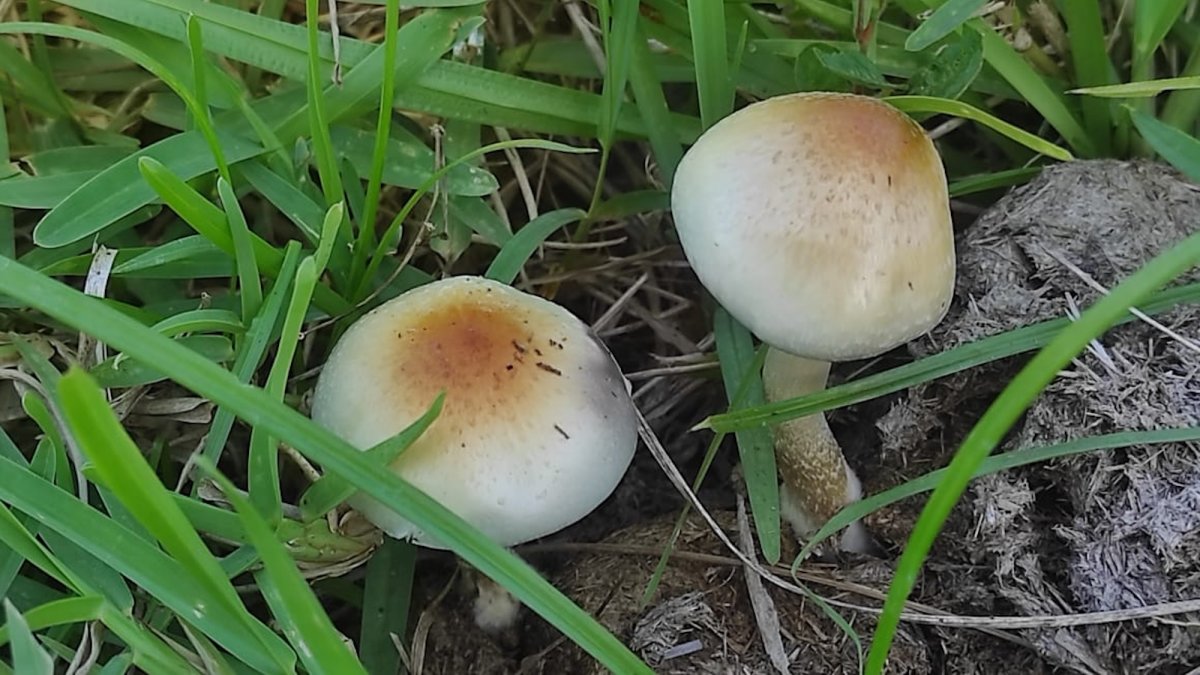
Over a decade ago, some clues to this mushroom dispersal puzzle were first uncovered. Researchers including Cathy Sharp at the Natural History Museum of Zimbabwe collected the first specimens of a psychedelic mushroom in the southeast African nation. The fungi looks remarkably like P. cubensis, with a yellowish color in the center of each mushroom cap. It’s even cultivated for similar uses under the names Natal super strength (NSS) and Transkei. But after analyzing sample DNA, study co-author Breyten van der Merwe confirmed that the African mushrooms were not P. cubensis at all.
“It’s one of the most popular strains of magic mushrooms, because it is quite potent and easy to grow,” the mycologist at Stellenbosch University in South Africa said in a statement. “But until this study, nobody realized it was a totally separate species from the classic magic mushroom.”
Catalogued as Psilocybe ochraceocentrata for its ochre—or yellow—coloration, the fungi possesses vastly different ecological, chemical, and genetic traits from P. cubensis. Sharp, van der Merwe, and colleagues also traced the origins of both P. ochraceocentrata and P. cubensis. They now believe cattle may not have introduced P. cubensis into the Americas. Instead, it may have been a starcrossed meeting—cows first met P. cubensis only after arriving on the American continents, then formed a mutually beneficial relationship.
The team cautions that more data is needed—African fungal diversity is vastly undersampled—but they have a few theories to explain the mushrooms’ evolution. One requires the involvement of both continents. While South America started diversifying millions of years ago, grazing herbivores began migrating out of Africa into Eurasia. This would explain both how both fungus species evolved and how cattle helped spread P. cubensis.
If nothing else, the discovery underscores just how much remains to be learned about the world’s fungi—and how they affect the humans that cultivate them.

2025 PopSci Best of What’s New
Environment,Biology,Sciencedrugs,fungi,News#psychedelic #fungus #rewrites #origins #magic #mushrooms1773185196

Recent Post



Gallery






Featured Videos