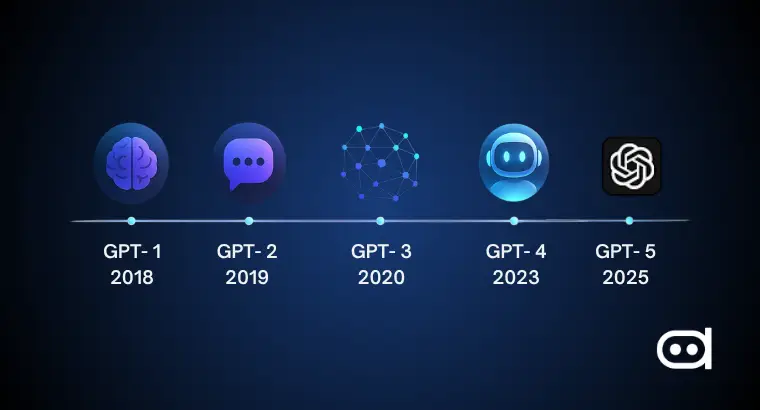
The Generative Pre-trained Transformer (GPT) series has changed artificial intelligence from a research curiosity to a mainstream tool, empowering innumerable interactions daily. The realization about the evolution of GPT versions over the years reveals how each one launched breakthroughs in language understanding and practical applications across industries.
GPT Version Comparison Table
| Features | GPT-1 | GPT-2 | GPT-3 | GPT-3.5 | GPT-4 | GPT-5 | GPT-5.2 |
| Release Date | June 2018 | Feb 2019 | June 2020 | Mar 2022 | Mar 2023 | Aug 2025 | December 2025 |
| Parameters | 117M | 1.5B | 175B | ~175B (optimized, fine-tuned) | Estimated 1T (not disclosed, mixture-of-experts architecture) | Estimated multi-trillion scale (MoE, highly efficient routing) | Not publicly disclosed |
| Training Data | Books + Wikipedia | Larger web crawl | Broad internet text, books, code | Expanded + fine-tuned dataset, human feedback | Vast, curated multilingual, multimodal data | Massive multimodal (text, image, audio, video, code) with continuous updates | Large-scale multi-domain data |
| Text Quality | Basic, coherent for short passages | More fluent, but still repetitive | Strong fluency, context up to 2048 tokens | More coherent, 4k–8k tokens, better reasoning | Human-like, 8k–32k+ tokens, advanced reasoning | Near human-level, deeper reasoning, context > 200k tokens | Highly structured, professional-grade outputs |
| Capabilities | Simple text generation | Storytelling, summarization | Coding, Q&A, creative writing | More stable, better chat, RLHF tuned | Multimodal (text + images), strong reasoning, advanced coding | Fully multimodal (text, image, audio, video), superior reasoning, planning, memory | Long-context reasoning, coding, vision, agentic workflows |
| Accessibility | Research only | Research + limited API | OpenAI API, enterprise integrations | API + ChatGPT free/Plus | Widely available via ChatGPT (Free/Plus/Enterprise) | Available via ChatGPT, Microsoft Copilot, enterprise APIs | ChatGPT & API |
| Architecture Improvements | Vanilla Transformer | Larger Transformer | Scaling breakthrough | Optimized transformers + instruction tuning | Mixture of Experts (MoE), multimodal architecture | Advanced MoE, improved efficiency, memory systems | Enhanced reasoning depth and tool coordination |
| Safety & Alignment | Minimal safeguards | Limited filtering | RLHF introduced | Safer, instruction-following | Reinforcement + Constitutional AI | Advanced alignment, real-time adaptation, global compliance | Improved factuality and mental-health safeguards |
| Use Cases | Research | Creative text experiments | Writing, coding, chatbots | Customer support, productivity, tutoring | Enterprise AI, multimodal apps, research | Complex workflows, enterprise automation, multimodal agents | Knowledge work, coding, research, automation |
| Integration | None | None | API integrations begin | Microsoft integration (Azure, Office) | Microsoft Copilot, ecosystem partners | Deeper ecosystem: Microsoft, Adobe, enterprise suites | None |
| Languages Supported | English only | Mostly English | Dozens of languages | ~95 languages | ~100+ languages, stronger multilingual fluency | 100+ languages, near parity with English in many | Multilingual |
| Pricing Plan | Not public | Not public | API pricing (per token) | API + ChatGPT Plus ($20/month) | ChatGPT Free (GPT-3.5), Plus (GPT-4), Enterprise | Likely tiered: Free (GPT-4), Plus/Pro (GPT-5), Enterprise custom | Not public |
The GPT Version Timeline: How AI Evolved Over the Years
GPT-1
Launched in June 2018, OpenAI’s initial GPT Version showcased the transformer architecture’s language generation capabilities, ushering its unsupervised pre-training, along with supervised fine-tuning, into the limelight. This breakthrough marked the birth of generative pre-trained transformers in natural language processing.
Main Features:
- First transformer decoder implementation for language generation
- Ability to transfer learning in NLP tasks.
- Generate contextually relevant text.
Challenges and Limitations:
- The limit of only 117 million parameters made it inept at interchanging complexities.
- Very repetitive and sometimes nonsensical outputs.
- Had to be very finely-tuned for any kind of task.
- No harm-prevention or content-filtering mechanisms included.
Who Should Use: Research only, and will never be available for commercial use.
GPT-2
Released in February 2019, GPT-2 expanded to 1.5 billion parameters and stunned researchers with its text fluency. OpenAI initially withheld the full model due to concerns over misinformation and malicious use. It became the first AI model to spark global debate on responsible release strategies.
Main Features:
- Increased parameters enabled sophisticated outputs.
- Improved text coherence and context understanding.
- Better at creative writing and working across domains without task-specific training.
Challenges and Limitations:
- Initial release restrictions due to safety concerns.
- Inconsistent outputs.
- Demanding computational load.
Who Should Use: Content creators, researchers, and developers through APIs and open-source implementations.
GPT-3
In June 2020, GPT-3 arrived with 175 billion parameters, setting a new benchmark for generative AI capabilities. Its human-like responses fueled applications across writing, coding, and creative industries. The release cemented OpenAI’s leadership in scaling large language models.
Main Features:
- Large-scale architecture enabling complex reasoning.
- Few-shot and zero-shot learning without fine-tuning.
- Exceptional performances in diverse subjects.
- Available through API for commercial applications.
- Supports over 100 languages.
Challenges and Limitations:
- High computational cost restricts its access.
- Inability to update itself with real-world knowledge.
- Produces outputs that can be potentially biased.
Who Should Use: Businesses, developers, and content creators through the OpenAI API with various pricing options.
GPT-3.5
Introduced in March 2022, GPT-3.5 refined GPT-3’s performance with better reasoning and factual accuracy. It powered the first public version of ChatGPT, transforming how people interact with AI conversationally. This update bridged the gap between research prototypes and real-world deployment.
Main Features:
- Integration of reinforcement learning from human feedback.
- Better at following instructions and conversation flow.
- Better at refusing inappropriate requests.
- Better factual accuracy and less harmful outputs.
- Optimized for dialog applications.
Challenges and Limitations:
- Knowledge cutoff prevents awareness of recent events.
- Sometimes gets shaky when dealing with uncertain information.
- Cannot retain information learned in separate individual conversations.
- Not so good at complex mathematical reasoning.
- Cannot browse the internet.
Who Should Use: Millions access it through ChatGPT’s free tier, and ChatGPT Plus subscribers ($20/ month) get priority access.
GPT-4
Debuting in March 2023, GPT-4 added multimodal capabilities, enabling understanding of both text and images. It brought major leaps in reliability, safety, and complex reasoning — powering ChatGPT Plus. Businesses adopted GPT-4 widely for content creation, analytics, and customer engagement.
Main Features:
- Text and image processing capability
- Greatly enhanced reasoning and coding abilities
- Better factual accuracy
- Better safety with human value alignment
- Plugin ecosystem for real-time information access
Challenges and Limitations:
- Less capable of image-generation than specialized models
- Token limits for processing longer documents
- Premium pricing, limiting accessibility
Who Should Use: Professionals, researchers, and businesses through ChatGPT Plus or API access.
GPT-5
Launched in August 2025, GPT-5 represents the next evolution in multimodal intelligence across text, vision, and audio. It introduces adaptive memory and real-time workflow integration for enterprise and creative applications. With GPT-5, OpenAI moves closer to a truly general-purpose AI that can learn, reason, and assist dynamically.
Main Features:
- Reasoning and problem-solving that almost reach human levels.
- One of the top multimodal ai model in 2025
- Extended memory and long conversation context.
- Agent-like behaviors to execute sub-tasks toward complex task execution.
- Stronger alignment and overarching safety protocols.
Challenges and Limitations:
- Initially available only to premium subscribers.
- Users might get over-reliant and lose their critical thinking.
- Continued accuracy issues in specialized domains.
- Concerns about job displacement and societal impact.
Who Should Use: Enterprise users and professionals via the ChatGPT Pro subscription ($200 a month).
GPT-5.2 (Current & Latest)
GPT-5.2 was introduced in December 2025 and is considered one of the most sophisticated GPT versions over the years tailored to professional knowledge and lengthy agentic tasks. One of the primary reasons why it is regarded as a significant turning point is that it was able to conquer the entire spectrum of writing, coding, data-analysis, vision, and multi-step workflows just to name a few. For instance, in the earlier versions, it could only answer questions, whereas GPT-5.2 is specifically optimized for performing whole tasks with total use of tools right from the starter to the finish line.
Main Features:
- Superior Vision: GPT‑5.2 has fewer hallucinations with a 30% reduction in occurrences of responses with errors on a set of de-identified queries from ChatGPT.
- Enhanced Agentic Capabilities: The areas of interactive coding, code reviews and bug finding have shown measurable improvements in this GPT version.
- Superior Coding Performance: The model has reached new levels of excellence in the field, outperforming the others in SWE-Bench Pro and other software engineering measurements.
- Expanded Long-Context Understanding: The Thinking of GPT‑5.2 is ranked highest on OpenAI MRCRv2. It can perform deep analysis, summarization, and synthesis of extensive documents such as contracts, research papers, and reports with precision.
Challenges and Limitations:
- Increased power consumption and cost as compared to the older OpenAI GPT timeline versions
- Generation of complex outputs may take longer than usual
- Humans are still needed to supervise the process of making critical decisions
Who Should Use: GPT-5.2 can be used by developers, researchers, enterprise teams, analysts, and users who regard AI as an integral part of their work every day.
The Future Beyond GPT-5.2
One would expect future GPT versions to incorporate the accrual of reasoning abilities, enhanced personalization, improved memory systems, and multimodal integration, i.e., systems that work across multiple sensory modalities, including text, audio, video, and others.
In simpler words, it’s believed that GPT-6 and beyond will:
- Greatly refine logical reasoning and solve math problems.
- Personalize brilliantly, creating personal learning plans based on the preferences and specific learning styles of individual users.
- Retains context across chats due to better remembering capacity.
- Handle the integration of an extremely advanced multimodal system arising from complex real-world scenarios
Potential problems:
- Increasing regulations and compliance requirements.
- Ethical questions regarding consciousness and rights for AI.
- AI alignment to guarantee that these models remain beneficial as their capabilities increase.
- Computational costs and energy consumption for both training and deployment.
FAQs
Why was GPT-2 considered dangerous initially?
OpenAI initially did not release GPT-2 in full over raised suspicions of nefarious use, though these concerns were largely manageable with safeguards in place.
Has ChatGPT gotten smarter?
Yes, over time, ChatGPT has improved in reasoning and accuracy. GPT-4 and GPT-5 have considerably improved in complex problem-solving skills.
How is GPT-4 different from GPT-3?
GPT-4 introduced multimodal capabilities for processing images and text, improved reasoning abilities, better safety measures against misuse, and better factual accuracy.
Is GPT-5 available to the public?
It is available through a ChatGPT Pro subscription and select API access.
Which GPT version powers ChatGPT today?
At present, ChatGPT offers GPT-3.5 for free use, GPT-4 for $20/month to Plus subscribers, and GPT-5 for $200/month to Pro subscribers.
Can GPT models replace human jobs?
GPT models increasingly automate certain tasks, but they augment rather than completely replace humans.
Technology & Innovation#GPT #Version #Timeline #GPT1 #GPT5.21768571221

Recent Post



Gallery






Featured Videos