Perhaps one of life’s hardest tasks is deciding what to do with a loved one’s—or even your own—bodily remains. Do you go the cremation route? What about human composting or a green burial? What’s the easiest option? But then, what’s the best option for planet Earth? If you want your last act on Earth to also be good for the Earth, what do you do?
Well, in a new episode of Popular Science’s Ask Us Anything podcast, we explore just that. We break down all the details around what’s the most eco-friendly burial option, from aquamation to conventional burials.
Ask Us Anything answers your most outlandish, mind-burning questions—from the everyday things you’ve always wondered to the bizarre things you never thought to ask. So, yes, there’s a reason we can’t launch all our trash into the sun and no, drinking cold water isn’t bad for you. If you have a question for us, send us a note. Nothing is too silly or simple.
This episode is based on the Popular Science article “Cremation or casket? Here’s the most eco-friendly burial option.”
Subscribe to Ask Us Anything
Listen and follow Ask Us Anything on your favorite podcast platform:
Spotify | Apple Podcasts | YouTube | Or wherever you get your podcasts.
Full Episode Transcript
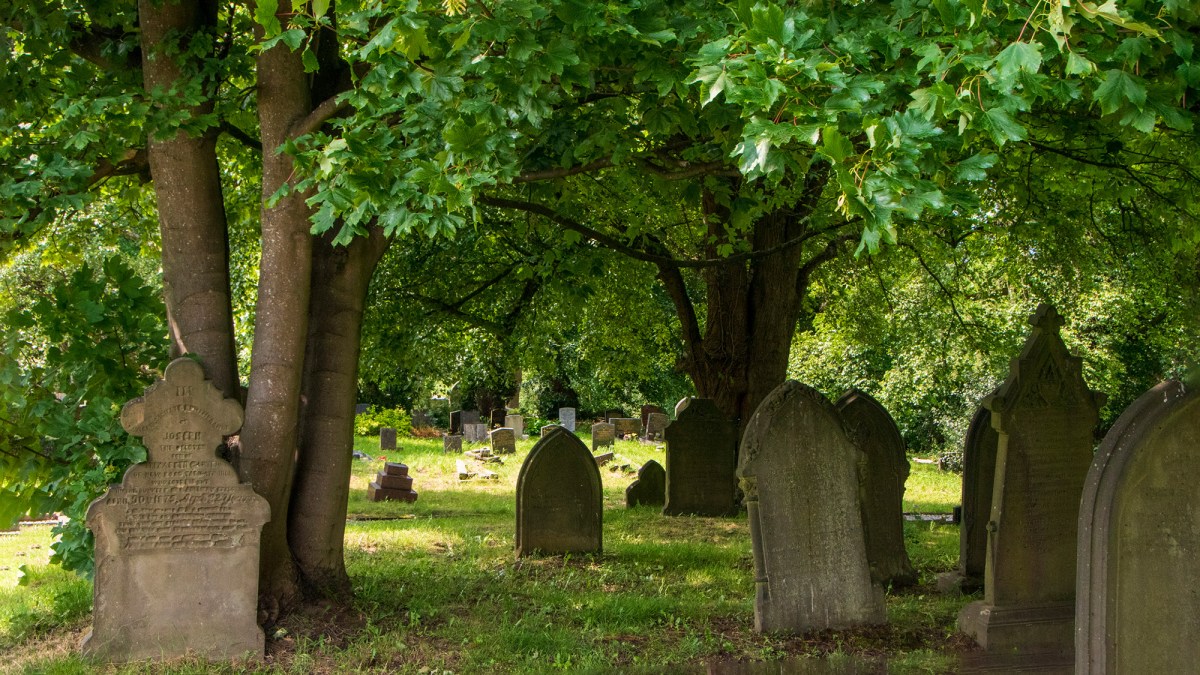
Sarah Durn: About 70 miles southwest of Asheville, North Carolina, a stunning preserve sits along the rolling foothills of the Appalachian Mountains. A dense canopy of trees—oaks, birches and maples—grow along carefully marked trails. Birds chirp. Rabbits scurry. And even black bears lumber through this luscious restored forest.
But this beautiful park is actually not a park at all. It’s a cemetery. Established in 1996, Ramsey Creek Preserve is largely considered the first modern green burial site in the United States. But is natural burial really the most eco-friendly way to go? How does it compare to cremation or newer technologies, like human composting?
If you want your final act on Earth to also be good for the Earth, what’s the best option?
Welcome to Ask Us Anything from the editors of Popular Science, where we answer your questions about our weird world, from “Do bears actually hibernate?” (Spoiler: They don’t.) to “Do carrots really help your eyesight?” No question is too zany or too simple. I’m Sarah Durn, features editor at Popular Science.
Laura Baisas: And I’m Laura Baisas, PopSci’s news editor.
SD: Here at PopSci, we’re always chasing questions, both big and small.
LB: And this week, our curiosity has led us to what’s the most eco-friendly burial option, something Sarah actually just edited a piece on. So if you’re worried about pollution, what is the best way to go?
SD: Yeah. Experts say there’s actually one very clear answer and it’s surprisingly simple. Want to guess?
LB: I’m gonna go with cremation.
SD: It’s actually natural burial.
LB: Oh, makes sense.
SD: Yeah. One of the sources for this story, Lee Webster, an author, educator, and former president of the Green Burial Council, told us that, “Everybody wants something shiny, new and exciting, but the simplest solution is usually the best.”
LB: I guess it’s one of those things that’s surprising, but not surprising.
SD: Yeah, totally. But there are some newer technologies on the horizon that might be even more sustainable.
LB: Ooh, intriguing. Now, before we bury ourselves in specifics, we want to know what questions are keeping you curious. If there’s something you’ve always wanted to know, submit your questions by clicking the “Ask Us” link at popsci.com/ask.
Again, that’s popsci.com/ask, and click the “Ask Us” link.
SD: We can’t wait to hear your questions!
LB: And with that, we’ll be right back after the short break.
Okay. So before we get into the carbon footprint math, I have to ask: Sarah, have you actually ever thought about what you want done with your body after you die?
SD: Ooh, wow. Starting light today.
LB: I’m in news: I like to keep things breezy.
SD: I mean, definitely, yeah. My instinct has always been something simple, minimal, like return me to nature. Very circle of life.
LB: Hmm.
SD: But with good trees.
LB: Love that. Kind of put me somewhere where the birds have some excellent Yelp reviews.
SD: Exactly. What about you?
LB: I used to think cremation since it felt really straightforward and flexible, since then I could be spread, you know, anywhere like my beloved ocean perhaps or maybe donating my body to a medical school.
But then once I started working on climate stories, I’m kind of like, “Oh, wait, no. Are my remains actually gonna be bad for the planet?”
SD: Yeah. Bad news. Maybe a little bit?
LB: Yeah. Kind of back to the drawing board, I guess.
SD: Yeah, but you know, don’t give yourself too hard a time. It’s worth remembering that humans have been trying to figure out the “right” way to handle a body for a very long time.
LB: Yeah, totally. And a lot of those methods would probably surprise some people today. Take for instance, sky burials. In some parts of Tibet, Mongolia and Bhutan, bodies are placed on mountaintops and left for vultures,
SD: Which sounds so magical—to become a bird.
LB: Right? It’s a sacred ritual in Buddhism, but it’s also practical.
In these areas, the ground is often too hard or rocky to dig into and fuel for cremation is scarce. So there’s a belief in returning the body to other living creatures as a final act of altruism.
SD: Hmm. I love that.
LB: And then you’ve got ossuaries where bodies are buried temporarily and later the bones are moved into communal, resting places to make room for the living.
SD: Oh yeah. I always think of those bone walls in Europe. They’re beautiful and a little metal.
LB: I’d say very metal, but again, super space efficient. But unfortunately, sky burials are actually illegal in the United States, and ossuaries, aka those bone walls, aren’t really an option either. So Sarah, how did today’s burial options stack up? What’s the most eco-friendly option?
SD: Yeah, well, let’s start with conventional burial because that’s still what many people picture. You’ve got embalming chemicals, hardware. They’re metal caskets. Often a concrete vault, deep hole in the ground. You kind of get the picture. Each of those materials requires mining, manufacturing, and transportation.
And once they’re stored, they’re basically permanent. So it’s a very resource intensive and carbon heavy process. And those chemical preservatives don’t really return anything to the ecosystem.
LB: So that means cremation must be somewhat better, right?
SD: Yeah. Cremation has the reputation of being the simpler, cleaner choice, but it requires a lot of heat, usually between 1400 and 1900 degrees Fahrenheit and that’s typically powered by fossil fuels.
LB: Oh, toasty.
SD: Yeah. Extremely toasty. Cremation also releases a fair bit of carbon dioxide and mercury vapor from dental fillings. Lee Webster, one of the sources for this story, told us that roughly 14 percent of all mercury in U.S. waterways is attributed to flame cremation.
LB: That is way higher than I expected!
SD: I know, right? It’s one of those out of sight processes that feels small because you don’t see the smokestack, but it’s there.
LB: And even traditional cremation pyres come with trade-offs, right?
SD: Yeah. One study in India found open-air cremations can use 880 to 1,100 pounds of wood per body releasing 500 to 600 kilograms of carbon dioxide, which is a lot.
Researchers there basically said, of course, these ancient rituals matter, but it would be great to find greener options.
LB: Okay, so then there are these newer technologies such as aquamation and human composting, which we actually did a whole episode on, and we’ll link in the show notes. But are these new methods actually better for the planet?
SD: Yeah, it’s complicated. They can definitely reduce some impacts, but they’re not impact free.
LB: Okay, let’s start with aquamation. What is it exactly?
SD: Aquamation, or alkaline hydrolysis, uses heated water and lye to break down soft tissue over about 12 hours. The bones then are left behind.
LB: And is it better than cremation?
SD: Definitely. Carbon emissions may be around 20 percent lower than flame cremation. But then you’re left with about 100 to 300 gallons of liquid waste that has to go into wastewater systems.
LB: Yikes. That’s a lot of waste. So what about human composting? I mean, it sounds like it could be good?
SD: Yeah, so human composting, also called natural organic reduction, which again if you want to learn more, check out our episode about it. This method happens in a vessel filled with materials like straw, wood chips, and alfalfa.
Microbes break down the body over about 60 days. But bones don’t fully reduce, so they’re refined and then mixed back in. The families end up with roughly 250 pounds of material that usually looks a lot more like wood chips than garden soil.
LB: That is a lot of you.
SD: Yeah. It’s basically a panda sized amount of soil. And often that material gets transported elsewhere for spreading. Plus some of the inputs like alfalfa are grown in water stress regions and shipped long distances.
LB: I kind of think all things should be measured in units of panda.
SD: Definitely.
LB: Just saying, so pandas are not the through line here is: even new options have issues.
SD: Lee Webster in our story compared it to grocery shopping. You can’t just trust the word organic. You have to know what went into it.
LB: Okay, so drum roll. After all of this analysis, what’s the winner? What’s the most eco-friendly way to go?
SD: Natural burial. No embalming, no vaults, no metal, just a biodegradable shroud or simple wooden box placed directly into the soil.
LB: Back to the basics.
SD: Exactly. Webster describes it as a body to Earth burial with no impediments to decomposition. Typically, the body is placed about three to four feet down where microbes and insects take it from there.
There’s no leftover material, no chemical runoff, and no machinery driven emissions. A 2017 lifecycle assessment found this method consistently has the lowest overall environmental cost of any burial method.
LB: So yeah, like with a lot of things, the most advanced climate solution is just doing less.
SD: Yeah.
LB: You know, there’s kind of something comforting about that.
SD: I think so too. And many natural burial sites double as conservation land, which means instead of depleting space, you’re actually helping to protect it.
LB: Right. So your final act could actually be habitat preservation.
SD: Right.
LB: So should we all just get buried in these simple biodegradable boxes?
SD: Maybe. But Webster did note that there might be a promising new approach on the horizon. This method would break down both soft tissue and bone into nutrient-rich material. It was developed by innovator Bob Jenkins and uses a proprietary mixture to transform remains into nutrient-rich material in an “accelerated manner.”
LB: Oh, interesting. So it’s kind of like super human composting.
SD: Yeah, I think so. But it’s not currently available, unfortunately.
LB: Honestly, after working on this, I almost feel a little skeptical of any new innovation here.
SD: Yeah, it’s very fair. It’ll be very hard to displace natural burials as the most eco-friendly option I think.
LB: I mean, simple and eco-friendly? Kind of hard to beat.
SD: Yeah, you know, I think I’m sold. Find me a box.
LB: And with that we’ll be right back to wrap up this episode with some of our own experiences with funerals.
SD: So we’ve spoken a lot today about burials and types of burials, but not as much about the funeral traditions that have helped humans mourn for centuries.
LB: Yeah. I think that those early days of the COVID-19 pandemic really made most of us realize how important being together is when a loved one dies.
SD: Yeah, definitely. It’s so hard when there’s no moment to mourn together.
LB: Yeah, exactly. So have you had any surprising moments or experiences come up at a funeral?
SD: You know, I did have a really unique experience when I studied abroad in New Delhi, India. My homestay sister’s grandmother passed away while I was there, and I actually attended her Hindu funeral, which I hadn’t had any prior experience.
LB: Right, right.
SD: Yeah. I remember how the family decorated her body with flowers in her apartment, which was just downstairs from where I stayed.
And then on the day of the funeral, there was an event under this open air tent where a Hindu priest recited some prayers in Sanskrit.
LB: So did the family and friends attending understand what was being said?
SD: No, they didn’t understand. It was kind of like the equivalent of going to like a Latin Mass in Catholicism
LB: That I understand.
But again, I imagine that was still really beautiful and moving even with that language barrier.
SD: Yeah, it was. And then after that we went to a separate place where the actual cremation happened. The body was placed on a funeral pyre just 10 feet in front of us. And that experience was, yeah, especially moving because it made me think how cremation happens in the States where it’s oftentimes removed from family and friends. So to be a part of that process felt much more, I guess, impactful. It involved you in the process much more directly.
LB: Right. That’s beautiful.
SD: Yeah. How about you?
LB: So I grew up Catholic, and was a church cantor for several years.
SD: Aw.
LB: Yeah. Cantering is when you lead all of the songs at a Mass. And thanks to that special set of skills, I’ve actually cantered at several family members’ funerals.
SD: Hmm.
LB: One was for my great aunt Alice, who actually lived with my immediate family growing up. She happened to love the Christmas song Silver Bells and would just kind of randomly sing it no matter what time of the year.
SD: Aw, that’s so sweet. I love that.
LB: Yeah, this woman was an absolute hoot. She died rather suddenly in November 2010, and so I was cantering and to honor her at the funeral, I asked the organist to play an instrumental of Silver Bells right after I sang one verse of the communion hymn, and I didn’t tell my family.
SD: Oh, were they surprised?
LB: Yeah, completely. It was just really nice to see them smile. And then my mom actually explained during her eulogy why everyone just heard a Christmas song in early November.
SD: Oh, helpful. But aw, so nice.
LB: Yeah, it was just one of those nice little reminders that she’s still with us and those types of things really helped during gatherings that are, you know, incredibly sad.
SD: Yeah, for sure.
And that’s it for this episode, but don’t worry, we’ve got more awesome Ask Us Anythings live in our feed right now. Follow or subscribe to ask us anything by Popular Science wherever you enjoy your podcast. And if you like our show, please leave a rating and review.
LB: We care what you think
SD: We do!
LB: Our theme music is from Kenneth Michael Regan, and our producer is Alan Haburchak. This week’s episode was based on an article written for Popular Science by Jennifer Byrne.
SD: Thank you team, and thanks everyone for listening.
LB: And one more time. If you have something you’ve always wondered about and wanted explained on a future episode, go to popsci.com/ask, and click the “Ask Us” link.
Until next time, keep the questions coming.
SD: Yay.

2025 PopSci Best of What’s New
Science,Ask Us Anything,Climate Change,Energy,Environmentevergreen,News,podcasts#ecofriendly #burial #option #isnt #cremation #human #composting1772831786

Recent Post



Gallery






Featured Videos