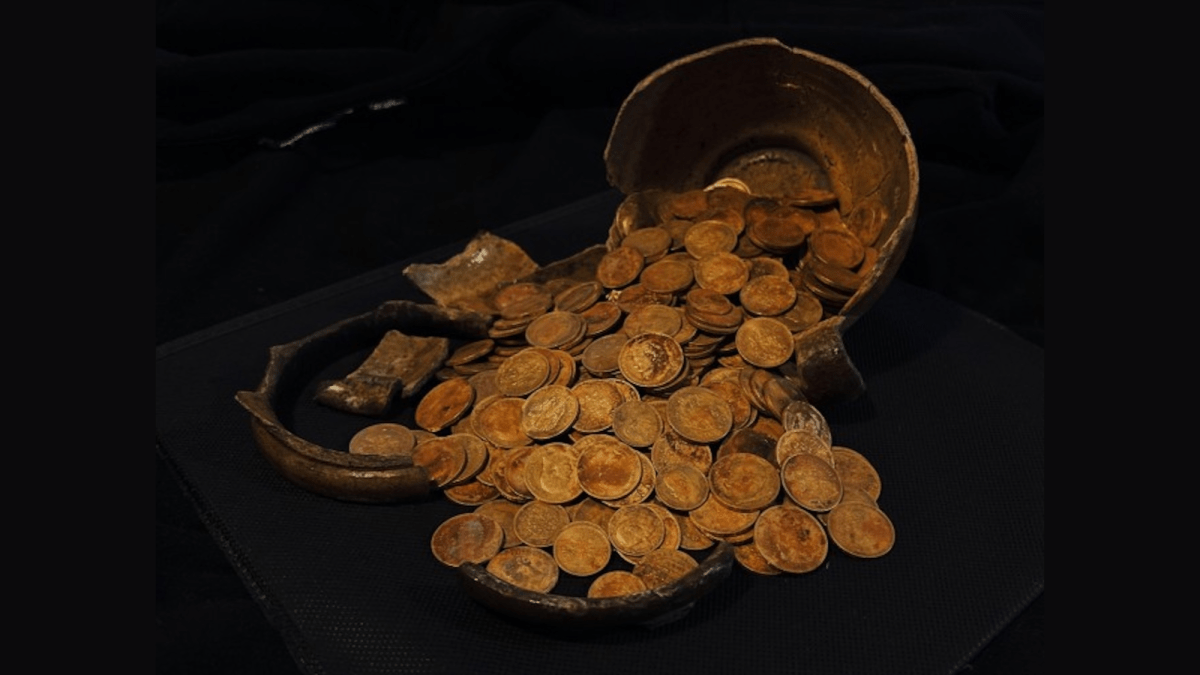
A remarkable trove of Russian history is finally seeing the light of day after spending nearly 110 years hidden underground. While surveying a historic home in the small town of Torzhok about 135 miles northwest of Moscow, archaeologists discovered a clay container filled with 409 gold coins buried beneath the structure’s foundation. Given their origins along with the context of their storage, researchers believe the cache was likely tucked away amid the turmoil of the Russian Revolution.
The collapse of Russia’s monarchy under the reign of Nicholas II is indisputably one of the most consequential and far reaching events of the 20th century. After hundreds of years of serfdom, the nation’s lower classes revolted against Tsarist rule in 1917 amid the backdrop of World War I. Five years of civil war ensued, culminating in the dissolution of royalty and the establishment of the Soviet Union.
It was a tumultuous and uncertain time for millions of Russians, forcing many families to safeguard their livelihoods and valuables however they could. The recent discovery in Torzhok appears to be one such example. Researchers at the Institute of Archaeology of the Russian Academy of Sciences found the treasure while conducting rescue excavations ahead of planned construction in the area. After removing a portion of stone foundation work from a historic home, the team uncovered a shattered kandyushka—a small, handled jar with a narrow neck. Amid the container’s remnants was an even more startling find: a total of 409 gold coins.
Subsequent cataloging revealed the coins were mostly 10-ruble pieces minted between 1848 and 1911. While the earliest examples date back to the reign of Tsar Nicholas I, most were created during his son Nicholas II’s tenure. Given the latest date on the coins, archaeologists suspect the funds were hidden away during the fallout of the Russian Revolution. The owner almost assuredly planned to one day retrieve their money, but for whatever reason never managed to return.
Although the coins’ original owner remains a mystery, historical records may help narrow down their possible identity. Primary sources show that 24 houses existed on that same street during the early 20th century. Between 1914 and 1921, residents of the area included priests, an accountant, storeowners, and various day laborers. Unfortunately, the street’s present-day addresses do not match the original numbering, so pinpointing the exact person who hid the coins isn’t possible yet. Despite this, future archaeological finds in the town may help one day match the treasure trove to its owner. In the meantime, historians and numismatists can continue to study the coins, which will soon go on display at the All-Russian Historical and Ethnographic Museum in Torzhok.

2025 PopSci Best of What’s New
Science,Archaeologyculture,history,News,russia#buried #jar #imperial #gold #coins #resurfaces #Russia1773077911