We may earn revenue from the products available on this page and participate in affiliate programs. Learn more ›
A typical power bank is meant to resurrect a dead smartphone or extend tablet usage through a long flight. But laptops fall into an entirely different category when it comes to backup power. The same goes for other power-hungry devices like drones, and even high-end cameras. I’ve been testing the Anker Prime Power Bank (20K, 200W) for several weeks with a number of different devices. In that time I’ve found it to be powerful, simple to use, and full of welcome features that make it enjoyable to use. It’s not perfect, but If you want one battery pack that can keep up with modern USB-C gear—and you’re willing to carry it—this is a great option.
Review: Anker Prime Power Bank (20K, 200W)
See It
Pros
- Real laptop output: Up to 140W on a single USB-C port, with 220W total available across ports.
- Fast to refill: 100W input means it can recharge in under an hour with the right charger and cable.
- Actually useful smarts: The on-device display gives real-time wattage and time estimates; the app is there if you want deeper tweaks.
Cons
- Price: It’s an investment, especially if you add accessories like the charging base.
- Weight: It’s “pocketable” on paper, but at over a pound you’ll feel it.
- Capacity reality check: This is a 20K-class pack (about 72Wh), not a full replacement for a laptop battery.
Design and Build
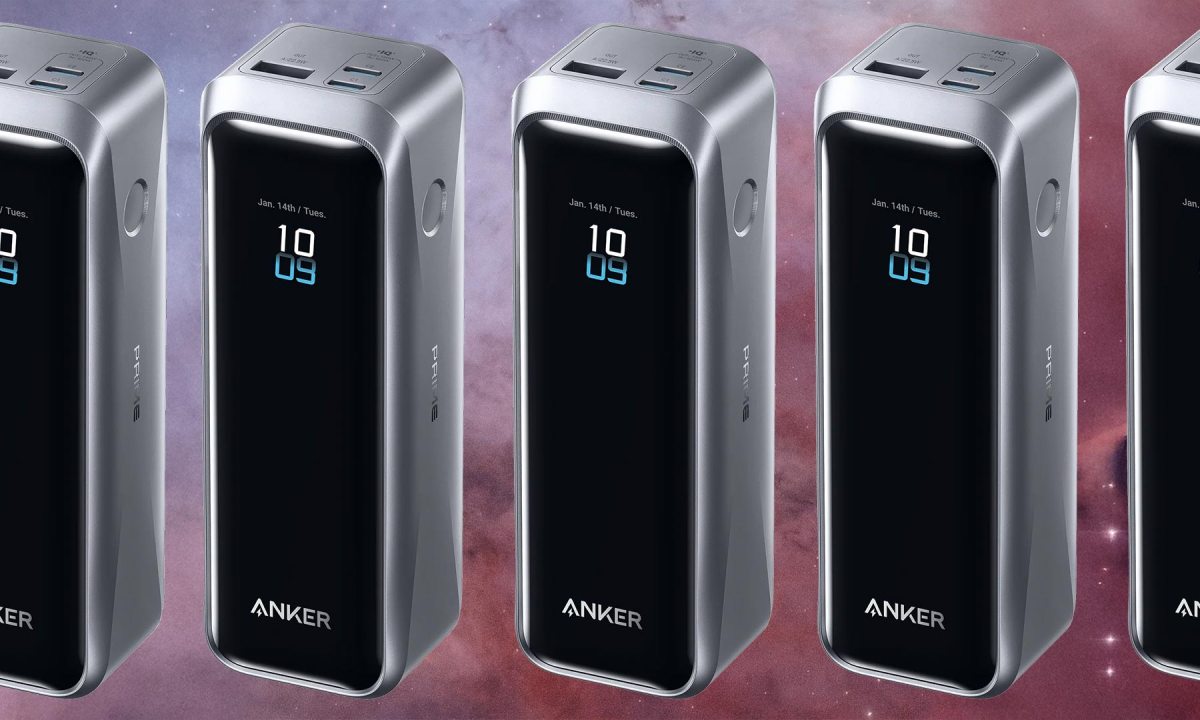
The Anker Prime 20K is roughly the size of one of those skinny Diet Coke cans, but it’s a squared-off soda can with real heft. It measures 1.73 × 1.99 × 5.79 inches and weighs 1.12 lbs (510 g), which makes it easy to stash in a backpack or camera bag—and a little silly to carry in a jacket pocket unless you’re committed.
Build quality is a standout. It’s a dense block of hardware rather than a hollow plastic shell, which matters when you’re throwing it into bags, bouncing between locations, or generally living the clumsy reality of travel.
Anker’s display is also genuinely helpful. Instead of the old system of four mystery LEDs, you get clear readouts for charge level, real-time wattage in/out, and time-to-empty or time-to-full estimates. When you’re trying to decide whether you have enough juice for a flight, a shoot, or a long coffee shop session, that kind of clarity is the difference between guessing and knowing. The shiny surface on the front of the device does pick up smudges and finger prints easily, but that doesn’t matter much to me.
Port layout is straightforward and practical: two USB-C ports and one USB-A across the top. In day-to-day use, I found it easier to lay it flat with the screen facing up so it’s less likely to tip if a stiff cable gets bumped.
How I tested Anker’s Prime Power Bank
In the several weeks I spent with this device, I used it to fuel my 14-inch MacBook Pro with an M3 Max chip inside. I also used it to charge an iPhone 17 Pro Max, DJI drone, Canon R5 Mark II camera, and other devices. In each case, I was able to hit maximum charging speeds with each device and even keep up with the MacBook Pro output during high-intensity tasks like exporting files from Adobe Lightroom.
The “System” Approach
You can absolutely buy the battery by itself and be happy. The main story here is that it refills fast enough (up to 100W input) that it’s easy to keep topped off between sessions—plug it in while you eat lunch and you’ll get a meaningful chunk of capacity back.
If you want a cleaner workflow that’s always ready, Anker also sells a separate $99 charging base that uses pogo pins and charges the bank at the same 100W rate. It’s not required, but if this power bank is part of your daily desk kit, docking it like a gadget from the future is undeniably convenient.
Performance
The “220W” in the name is the combined ceiling across ports. In practical terms, it means you can run a laptop at serious speed and still charge other devices without everything collapsing into “slow charge” mode.
- Single port: One USB-C port can deliver up to 140W (PD 3.1), which is enough to charge a MacBook Pro at full speed.
- Multi-device: With 220W total available, you can keep a laptop happy while also topping off a phone, tablet, camera, or accessory—without feeling like you have to “schedule” charging.
Thermals are solid, too. High-wattage power banks often get uncomfortably warm when they’re actually delivering big power for long stretches. This one stayed surprisingly composed during sustained use, which inspires more confidence than raw spec-sheet bragging ever could. It felt noticeably warm to the touch when it was charging up its own internal batteries, but it never got hot.
The companion app is a nice touch, but I didn’t find myself using it all that often during normal use. The built-in screen typically told me what I needed to know.
At this price point, I would have liked an integrated cable and possibly wireless charging as it requires a separate cable to input and output power. That’s not super common with models in this class, so it’s not a point against this model, but both features would have been welcome.
Comparison: Anker Prime 20K vs. The Competition
The Anker Prime 20K sits in a sweet spot: smaller and lighter than the max-capacity carry-on limit bricks, but far more capable than the average travel power bank.
| Feature | Anker Prime 20K (220W) | EcoFlow RAPID Pro (27,650mAh) | Shargeek Storm 2 | Anker 737 (24K, 140W) |
|---|---|---|---|---|
| Capacity | 20,100mAh (~72Wh) | 27,650mAh (99.54Wh) | 25,600mAh (93.5Wh) | 24,000mAh |
| Max Output | 220W total (140W single USB-C) | 300W total (up to 140W single) | 100W (single-port fast charge class) | 140W max total |
| Max Input | 100W | 320W (with matching station) | 100W in/out | 140W two-way charging class |
| Ports | 2× USB-C, 1× USB-A | 4 total (incl. built-in retractable USB-C cable) | USB-C + USB-A + DC + more | 2× USB-C, 1× USB-A |
| Weight | 1.12 lb (510g) | 699.4g | 591.3g | 630g |
| Unique Feature | Optional pogo-pin charging base + strong on-device display | Built-in retractable cable + modular accessories | “Gadget-core” transparent design + DC output | More affordable entry to 140W-class charging |
The Specs
| Category | Specification |
|---|---|
| Model | Anker Prime Power Bank (20K, 220W) |
| Capacity | 20,100mAh (~72Wh) Carry-on compliant under 100Wh |
| Ports | 2× USB-C, 1× USB-A |
| Single USB-C Max | Up to 140W |
| Combined Max Output | Up to 220W total |
| Recharge Speed | Up to 100W (USB-C) / Up to 100W (charging base) |
| Connectivity | Bluetooth (Anker app) |
| Dimensions | 1.73 × 1.99 × 5.79 inches |
| Weight | 1.12 lb (510g) |
Verdict
If you’re truly a power user—or you just have a laptop that laughs at most power banks—this Anker Prime makes a compelling case. The headline isn’t just big number wattage. It’s that the wattage shows up in real use: no slow-charger warnings, no weird throttling, and no all-night recharge penalty once you’ve drained it.
If you only need to charge a phone, this is unnecessary weight and money. But for photographers, frequent travelers, and anyone trying to keep a MacBook and a few other devices alive away from the wall, the Prime 20K feels like the first power bank that actually behaves like it belongs in a modern USB-C workflow.

2025 PopSci Outdoor Gift Guide
Gear,ComputersNews,reviews#Anker #Prime #Power #Bank #20K #200W #review #Plenty #power #laptops1768492689