Offices returned as the most preferred asset class for the first time since 2020, ahead of Industrial & Logistics. Data centres also feature strongly, with investors looking to build scale in this sector.
Investors’ Preferred Sector for Investment (% of respondents)
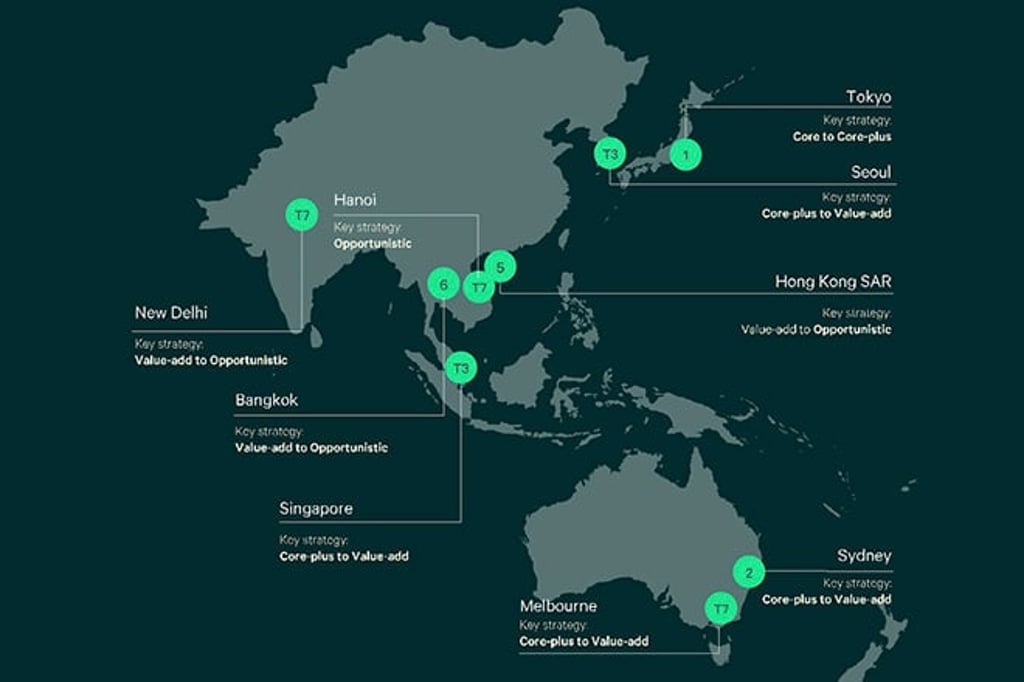
Cross-border preferences remain consistent. Tokyo holds the position as the most preferred investment destination for the seventh successive year, followed by Sydney, with Singapore and Seoul sharing third place.
Hong Kong SAR has returned to the top five preferred cross-border destinations after a short absence. This resurgence is underpinned by renewed interest from mainland Chinese investors, together with activity in living sectors and hotels, including opportunities for asset repurposing, such as conversions of underused hotels into student accommodation to meet demand from non-local students.
Top Cities for Cross-Border Investment and Preferred Strategy
“The selectivity behind the recovery in investment sentiment is particularly evident in 2026. Investors are concentrating on markets where there is greater price visibility from comparable transaction activity and stabilised cap rates, occupier demand is resilient, and financing conditions are improving,” said Ada Choi, Head of Research, Asia Pacific at CBRE.
“That combination is fostering a measured return of confidence and a willingness to deploy capital, particularly into high quality assets with visible income durability,” she added.
Office vacancy tightens across mature markets
In the office sector, leasing demand is set to strengthen across mature central business districts, as occupiers place greater emphasis on core locations and buildings that offer superior amenities.
Expansion is anticipated from technology firms, wealth management companies, and professional services providers, which continue to seek quality space amid stricter attendance policies and AI integration.
Regional office supply across Asia Pacific is expected to peak this year, with mainland China and India accounting for the lion’s share of new stock. Vacancy is forecast to remain low in markets such as Tokyo, Korea and Singapore, while availability in Australia and Hong Kong SAR will tighten.
According to CBRE’s Hong Kong Market Outlook 2026, financial occupiers are maintaining steady requirements, supplemented by selective acquisitions from mainland Chinese entities, which should aid further stabilisation and bring vacancy improvements from last year’s levels. Prime districts including Central and the emerging cluster in Tsim Sha Tsui West are likely to draw sustained interest.
Industrial and logistics rental momentum moderates amid caution
The industrial and logistics market will see rental growth persist in most locations, yet the pace is expected to ease as occupiers adopt a more cautious stance on expansion plans amid softer economic momentum.
Renewals and consolidations nearer urban centres are likely to take priority, alongside facilities designed for automation, large floorplates and smart systems.
New supply is projected to reach its high point through 2026 before dropping sharply from 2027, as developers respond to elevated costs and moderated rental trends. Nearshoring and supply chain diversification are providing support to India and Southeast Asia, while oversupplied pockets in mainland China continue to encounter short-term challenges.
Prime retail leasing gains ground
Retail leasing is forecast to gain further ground from 2025 levels, underpinned by constrained vacancy in prime areas and limited new development pipelines.
Rents should hold to a steady upward course across most markets, driven by tenants in fashion, sports and athleisure, and experiential categories that prioritise omnichannel upgrades and flagship stores.
Retailers will focus on upgrading existing stores or relocating to prime locations. “With tight vacancy in prime areas and limited future supply, retailers should act quickly and decisively to secure their desired space. For landlords, they should rethink their offering and refresh their tenant mix to enhance engagement, while retailers can integrate experiential elements into their retail spaces,” said Choi.
In Hong Kong, the arrival of non-local students and skilled workers, combined with a packed events calendar, is expected to lift footfall and boost requirements for retail and food & beverage space, thereby sustaining momentum in prime high-street areas.
Hotel conversions address shifting requirements
In the hotels sector, performance growth is likely to moderate as tourism arrivals draw closer to pre-pandemic levels, leading to more tempered year-on-year rises in revenue per available room. Event-driven travel will remain a reliable driver of demand, even as outbound flows from mainland China stay subdued.
Property owners and operators are turning to conversions by, for example, transforming hotels into student or living accommodation in markets such as Hong Kong SAR and Australia, to meet evolving needs and capitalise on stronger demand in alternative uses.
Recalibration and innovation are essential
Overall, 2026 presents a positive environment for Asia Pacific’s commercial real estate sector, with investment volume expected to increase, strengthening interest in the office sector, and improving leasing demand. However, headwinds remain in the form of geopolitical and trade uncertainty, which will have an influence on real estate strategy in the year ahead.
“Against the backdrop of a rapidly shifting economic and real estate landscape, the ability for occupiers and investors to recalibrate and innovate will be critical,” said Choi.
“To effectively navigate evolving conditions, occupiers and investors need to actively review their existing strategies, portfolios and requirements, while embracing new sectors, technologies and approaches.”
South China Morning Post, News, Opinion, China, Hong Kong, World, US, Asia, Business, Economy, Technology, Lifestyle, Sport#CBRE #forecasts #positive #momentum #APAC #real #estate #market1773245835