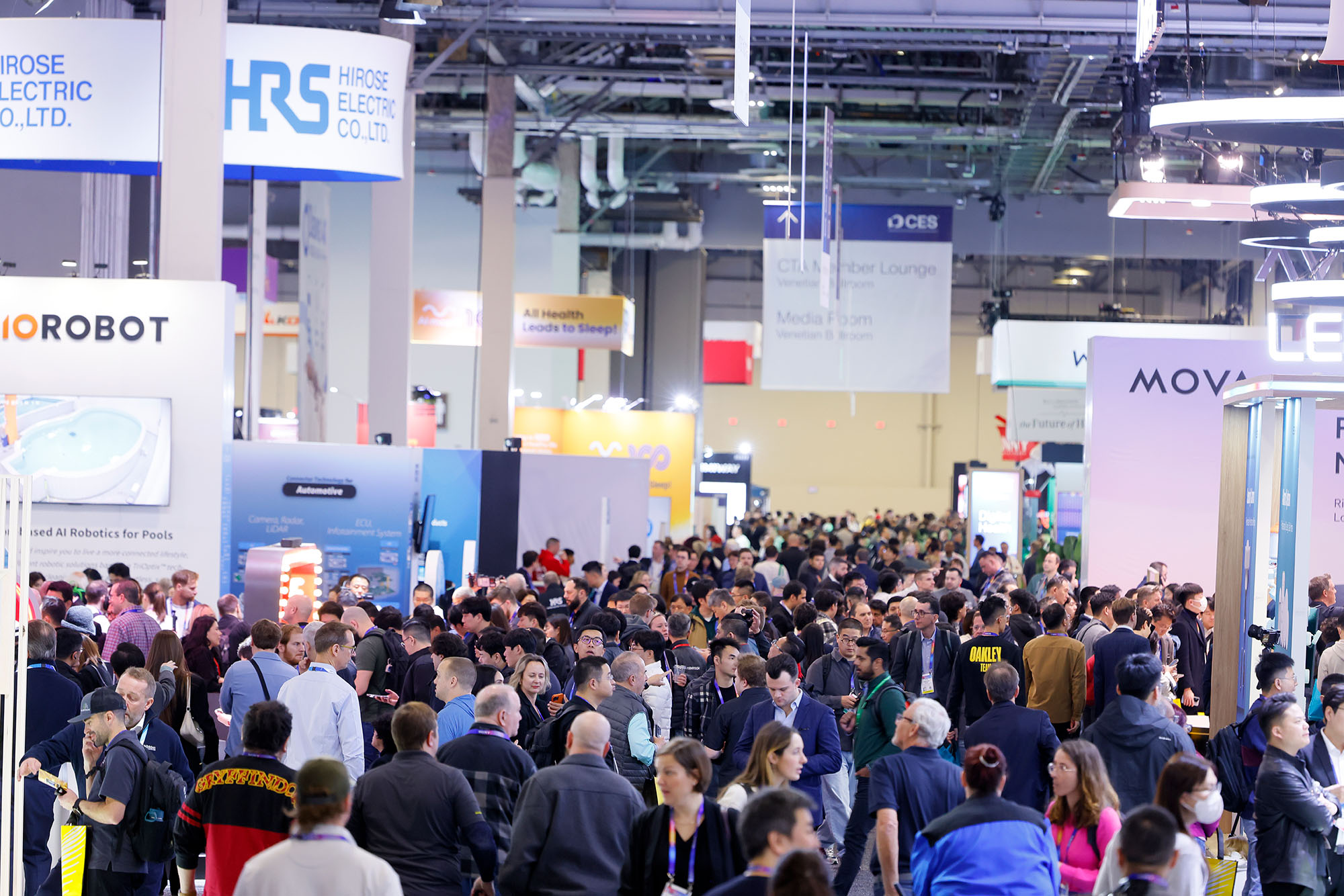
Every year, CES turns Las Vegas into a temporary future, equal parts prototype parade and endurance sport. Walk any aisle, and you could spot something that’s faster, brighter, louder, weirder … something that everyone will be talking about. And we’re here, on the hunt for those big reveals, the upgrades that just hit different. We’re scouting the optimistic spec sheets and collecting first-hand gear impressions that we’ll share with you once we’re back. But before the halls open, we wanted to share this sneak peek at just some of our hit list.
What we’re excited to see …
Taking place January 6–9, but already previewed by major manufacturers, CES 2026 is shaping up to be the year LCD admits it wasn’t done evolving, it just wanted a better backlight. Samsung is marching Micro RGB out of the 115-inch stratosphere (actually 130-inch mesosphere, as a proof-of-concept was announced on our first night here) and into living-room sizes (55” up), using tiny RGB LEDs for tighter color control and cleaner brightness without the usual white-light compromises. LG’s counterpunch is its Micro RGB evo flagship, with its full-gamut sashay—plus a new anti-glare Gallery TV to treat Mini-LED like museum lighting. Hisense keeps leaning into its TriChroma/RGB approach—pure colors at the source, big-screen theater energy, and local dimming panache. TCL, meanwhile, is bringing peak-brightness SQD-Mini LED potency (the 10,000 nits X11L) and its first RGB Mini-LED sets (Q10M Ultra, Q9M), basically betting on its Deep Color System and Halo Control for HDR fireworks that still hold their hues. OLED who? (But don’t worry, LG for sure has some impressive Wallpaper OLED TVs to show off.)


PopSci’s projector coverage has been leaning into a simple truth: the “TV replacement” era is already here. CES 2026 is singing that tune with a laser-lit chorus. Hisense is hauling in two machines: the XR10 long-throw (65–300 inches) with a new LPU 3.0 engine and a pure RGB triple-laser engine rated at 6,000 ANSI lumens, plus an IRIS system and sealed liquid cooling to hold contrast in a compact shell. Then there’s the PX4-Pro, a PX3-Pro follow-up UST aiming for a 200-inch picture, 3,500 ANSI lumens with TriChroma color, and a 6,000:1 contrast bump via a new IRIS lens system. XGIMI, which we clocked stepping into the pro lane with TITAN at IFA 2025 back in September, is at CES with a TITAN Noir Max Series refresh and a dynamic iris that makes contrast feel like lighting design, not math. Meanwhile, AWOL Vision and Valerion are sharing a booth, building on the launch of the VisionMaster Max as a cinephile standout for black levels in paticular. Now AWOL’s Aetherion Max/Pro UST wants to keep alignment PixelLocked, offering the kind of sharpness that makes people lean in and grin as screens balloon to 200 inches. They’re also chasing gaming-grade speed (1ms-class, 240Hz, VRR, Dolby Vision Gaming) and next-gen wireless like Wi-Fi 7, while still sweating color fringing and focus falloff. And Samsung’s Freestyle+ may not be competing in the brightness wars at 430 ISO lumens, but this easily transported cylinder’s AI-enabled auto-adaptations (3D Auto-Keystone, Real-Time Focus, Wall Calibration, Screen Fit) make it hard to beat for plug-and-play supremacy.
And we’re keeping a particularly close eye on how Dolby Vision 2 and HDR10+ Advanced factors into this future.
Here at PopSci, we also love to be as close to in the moment as possible, so we love it when connected tech can make us feel more connected to the real world, which the original Birdbuddy did. Sequel to a highly successful Kickstarter, Birdbuddy 2 is a smart feeder that behaves like a camera rig. The new flagship shoots 2K HDR with slow-mo across a 135° view, flips portrait-to-landscape, and wakes instantly so the “good” visitor isn’t gone by frame two. An improved mic listens for birdsong while vision AI tags species, and Gorilla Glass plus dual-band Wi-Fi and dual solar panels promise fewer ladder climbs. The faster capture and smarter ID make the system more autonomous, which means we’ll never miss a glimpse at a feathered friend. A new Mini keeps the core camera, shrinks the shell.
What we’re excited to hear …
CES can sometimes feel like a screen fest, but some of our favorite things are the systems that accompany them, that try and make sound waves behave in living rooms and car cabins. Spatial sound has been a major theme for us going into this year, so we’re looking for setups that feel less like demo tricks and more like things you’ll actually use for cleaner dialogue, better positional cues, and more immersive sound without more intrusive hardware.
Pioneer is bringing its in-car spatial audio concept to 2026 as a bolt-on reality. SPHERA is a 10.1-inch in-dash receiver that enables Dolby Atmos playback through Apple CarPlay, turning a compatible cabin into a little dome where you can appreciate sounds positioned with creator intent instead of merely panning left-right. The trick is practical: take an Atmos pipeline and add PURE Autotuning, time-aligning, and EQ to your existing speakers until the sweet spot feels centered, not smeared. Quick Swipe, split-screen, wireless CarPlay/Android Auto, and a Luminous Bar seal the gadget vibe without requiring a 19+ channel system in a luxury EV SUV (or costing $55,000-$80,000).


Maxwell 2 is the sequel gaming geeks crave: take a favorite and tighten every screw. We declared the original Maxwell as a standout across platforms for 90mm planar punch and FILTER noise-busting comms, plus Dolby Atmos support and absurd battery life. Now Audeze drags SLAM tech—acoustic modulation vents first shown in the flagship CRBN2 and trickled down to the LCD-S20—into a headset built for marathon raids. Thanks to the 10Hz–50kHz frequency response, I can hear footsteps snap into place, feel bass hit harder without blur, and just keep playing. And that will be easier with magnetic pads for quick swaps, AI mic cleanup, a low-latency USB-C dongle, Bluetooth 5.3 with LE Audio/LDAC, and 80-plus hours on tap—plus a cleaner, quicker new Audeze app.
Samsung’s 2026 audio push has plenty of software polish, with its updated Q990H soundbar adding Sound Elevation for nudging dialogue toward the screen’s center and Auto Volume for smoothing jumps. But the real sonic catnip is Music Studio 7 (left, below). A sculpted Wi-Fi speaker that’s built like décor (a “timeless dot” aesthetic) and tuned like gear, it throws 3.1.1 spatial audio with left-, right-, and top-firing channels, Pattern Control to keep the stage uncluttered, and Hi-Res 24/96 processing for bite and air. Solo, it’s a one-box lean-in Dolby Atmos listen. Paired with a compatible Samsung TV in Q-Symphony, one or more can stack, with or without a soundbar, for wider, taller, more action-anchored home cinema and no extra cable chaos. (And there’s a more curvaceous twin-tweeter Music Studio 5 on the horizon, as well. Think vinyl records and staff notation as visual inspiration.)


When we heard TCL’s Z100 speakers—the first-to-retail Dolby Atmos FlexConnect setup—our takeaway was simple: we can get behind surround sound that adapts to the room instead of punishing it with the need to rearrange. Now, heading into CES 2026, FlexConnect is no longer a one-off experiment tied to a single speaker kit. Dolby and LG are pushing it into a bigger, more “traditional” living-room shape—a modular, auto-tuning ecosystem anchored by the world’s first FlexConnect-powered soundbar (right, above), the LG H7, and promising the same “place speakers where they fit” freedom using LG’s latest premium TVs as a hub (and even select 2025 models via a future software update). It’s a bigger, cleaner, less fussy system that can scale from two boxes, done to a 13.1.7 layout across 27 configurations, if desired, making object-based audio feel special without needing a specialist.
TCL’s A65K Design Series soundbar is a slim black blade that wants to make your couch vibrate without making your room look like a cable crime scene. It’s a 3.1.2 setup with a wireless sub and up-firing drivers, so Atmos cues don’t just get louder; they launch, hover, and swell, effortlessly. Up to 460 watts, HDMI eARC, Bluetooth 5.3, and AI room calibration mean it’s built to lock in fast and sound “right” in whatever weird-shaped living room it lands in. The signature sauce is Audio by Bang & Olufsen—the Danish design-and-hi-fi institution famous for sculptural speakers and rich, musicality-obsessed voicing—and it’s not just here: TCL’s upcoming X11L Series SQD-Mini LED TV carries the same B&O audio co-sign, too. It’s the merger of picture and sound into one dynamic aesthetic.
What we’re excited to feel …
Elation! Confusion? A swift spiritual kick to the head?!? CES always promises (and delivers) sensory overload, and we’re sure 2026 will be no different. Part of the fun is coming across an interactive exhibit that really has people engaged.
So that’s just a taste of what we expect to see from these brands and many more. Some other previews we know we’ll attend: Sony, Garmin, Razer, Govee, Segway … just to name a few. By the time you read this, we’ll already have sore feet. By the end of the week, we’ll have a camera roll full of close-ups of ports, panels, and “wait, what was that?” But we’ll also have the best thing CES can give you: perspective on what tech will look like in 2026, and what press releases turn into things you’ll actually want in your living room. Beyond what’s here, we expect more personal audio, gaming monitors, smartphone accessories, robot vacuums (and mowers and clothesfolders and companions), plus other smart-home/kitchen appliances, etc. So, after our power walks and protein bar meals, we’ll report back on our hands-on winners.

2025 PopSci Outdoor Gift Guide
GearCommerce,evergreen,reviews,roundup#CES #tech #excites #fly #thousands #miles #walk #hundreds1767642204