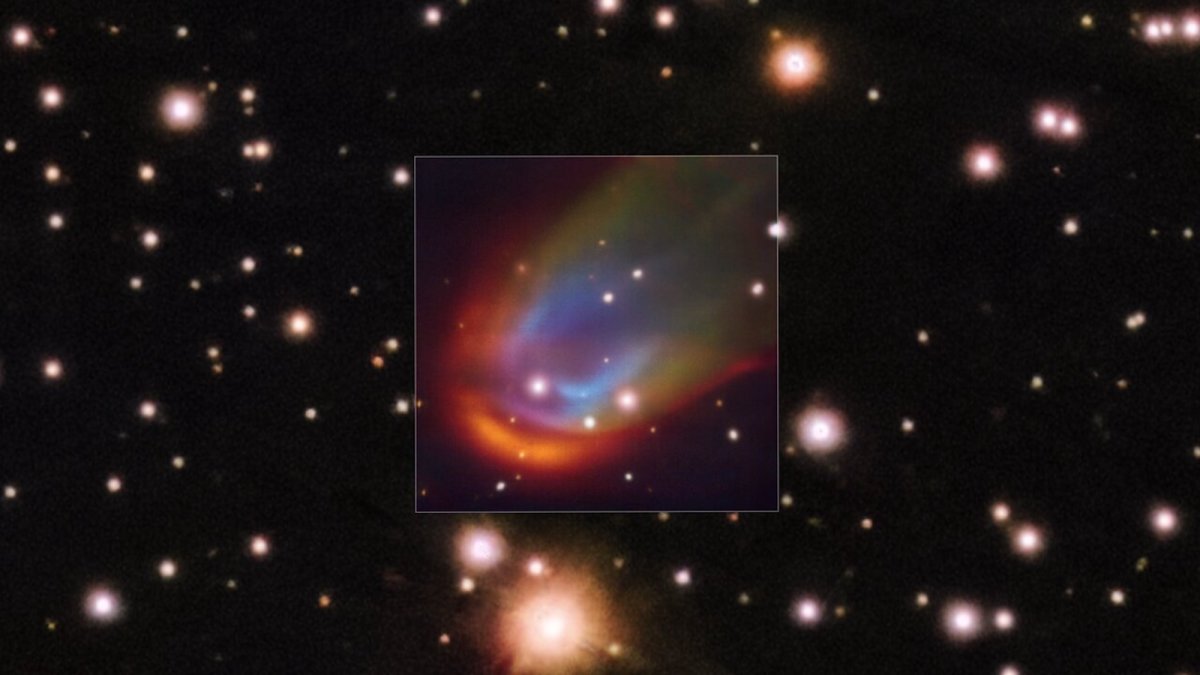
A star spends its entire life influencing the cosmos across billions of miles in all directions. In certain circumstances, the surrounding gas and dust plumes will even interact to generate powerful, observable shockwaves. However, once its nuclear fuel is completely expended, a star is often reduced to a dense, inactive core that floats through space with little impact on its surroundings. So when astronomers detected shock waves emanating from a dead stellar object 730 light-years from Earth, they were understandably perplexed.
“We found something never seen before and, more importantly, entirely unexpected,” explained Simone Scaringi, a researcher at Durham University in the United Kingdom.
As Scaringi and her team describe in a study published today in the journal Nature Astronomy, they first noticed curious signals from the white dwarf RXJ0528+2838 while analyzing images taken by Spain’s Isaac Newton Telescope. A white dwarf is what remains after the death of a low-mass star, and sometimes exists in a binary system with another stellar object. In this case, RXJ0528+2838 is orbited by a still-living star similar in size to our sun.

An unexpected shock wave
In such cases, material from the active star is usually siphoned to the white dwarf to form a disk of debris around it. Some of this energy is then also hurled into space in what are known as outflows. But RXJ0528+2838 doesn’t feature a disk, so the dead star shouldn’t create such a curved, “bow shock” outflow or its resultant nebula—yet it does. What’s more, the white dwarf’s outflow has billowed for at least 1,000 years.
“Our observations reveal a powerful outflow that, according to our current understanding, shouldn’t be there.” added Krystian Iłkiewicz, a study co-author at Poland’s Nicolaus Copernicus Astronomical Center.
To further investigate the cosmic anomaly, the team used the Multi-Unit Spectroscopic Explorer (MUSE) inside the European Southern Observatory’s Very Large Telescope. MUSE helped the researchers construct a detailed map of the bow shock and its composition, which they traced back to RXJ0528+2838 instead of an unrelated dust cloud or nebula.
The team confirmed that RXJ0528+2838 also possesses a strong magnetic field that allows it to gather material from its companion. While more examinations are needed, they believe it’s this magnetic field that can help explain the dead star’s strange behavior.
“Our finding shows that even without a disc, these systems can drive powerful outflows, revealing a mechanism we do not yet understand,” said Iłkiewicz, adding that their new study now “challenges the standard picture of how matter moves and interacts in these extreme binary systems.”
There are still many unanswered questions about this never-before-seen cosmic relationship. Importantly, the magnetic field Scaringi calls the white dwarf’s “mystery engine” doesn’t seem strong enough to generate the observed bow shock. Instead, the current field should power an outflow that only lasts a few hundred years. But with additional investigation, the astronomers hope to one day solve the discovery that no one saw coming.
“The surprise that a supposedly quiet, discless system could drive such a spectacular nebula was one of those rare ‘wow’ moments,” said Scaringi.

2025 PopSci Outdoor Gift Guide
Science,Deep Space,Space,Space Telescope,TechnologyNews,stars#Dead #star #emits #perplexing #shock #wave #years1768239358