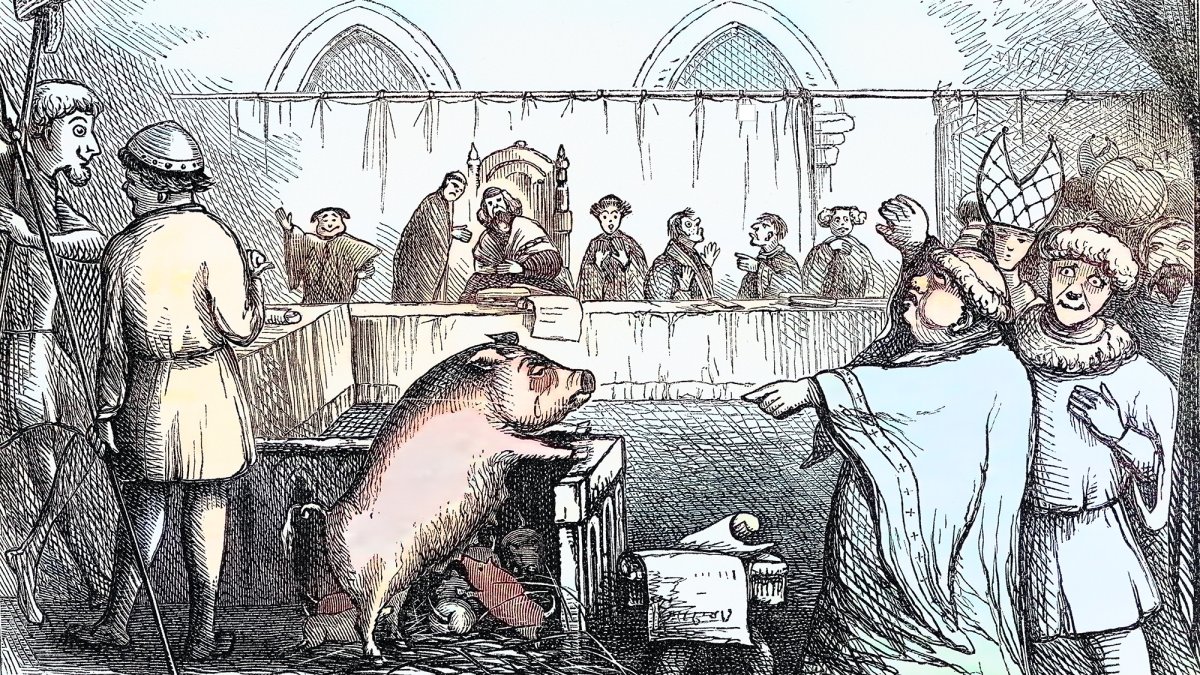
It’s a common scene in many films set in medieval Europe: a wooden cart wheeling its way through a jeering crowd of townsfolk, taking a condemned prisoner to the gallows.
However, reality is sometimes stranger than fiction. Because sometimes the criminal wheeled about town wasn’t human. Occasionally, the prisoner at the end of the rope was a pig, hung upside down until dead. In medieval Europe, pigs went to trial—and the gallows—surprisingly often.
Most of us don’t live on farms today, so it can be easy to forget how dangerous domesticated animals can be. Cows can trample people to death, horses can deliver fatal kicks, and those are just the herbivores. Pigs, on the other hand, are omnivorous. Throughout history, this made them useful as they could be fed kitchen scraps and waste. Yet a pig allowed to wander freely could easily overpower a small child, and as a result, there are hundreds of records of pigs killing and eating children across medieval Europe.
Medieval pigs could and would kill children
In 1379, a group of pigs in the village of Saint-Marcel-lès-Jussey in eastern France killed a swineherd’s child. In 1386, a sow in Falaise, Normandy, savaged a young boy, who died of his injuries. In 1457, a sow killed five-year-old Jehan Martin in the village of Savigny in Burgundy. Gruesomely, the sow’s six piglets were nearby, covered in blood.
“We are used to this pink, fluffy, or quite chubby animal that would be quite slow, but pigs in the Middle Ages were much closer to the wild boar,” says Sven Gins, a historian and a researcher at the University of Groningen, as well as the author of Casting Justice Before Swine: Late Mediaeval Pig Trials as Instances of Human Exceptionalism. “So they were very fast, very strong, and they ate everything, including human meat sometimes.”
Some pigs even went to trial for their crimes
In France, these incidents often resulted in trials, with the pig treated almost as a human defendant. “A lot of the records are saying, ‘This pig went to jail. This pig was transported in a cart. We got an executioner from Paris, and we paid him,’” says Gins. “These are very serious legal proceedings, in many cases. Almost mundane, actually. To us, it’s sensational that they would put a pig on trial, but to people at the time, it seemed [like] an ordinary thing to do.”
Gins notes that, as wild as pig trials sound, their purpose may have been practical. “One thing that is often not mentioned is that justice in general at the time was very much focused on reconciliation between the two parties,” he says. Sometimes, all it took was a payment from one side to the other to resolve an issue. “But then if a child is killed, that’s quite major, and money isn’t always going to cut it. So in that case, it helps if the law steps in and says, ‘We’ll take over from here.’”
Taking a pig to trial gave authorities a chance to dig deeper. “They sometimes wanted to know, was there any ill-intent present in this? If you know that a pig is dangerous, why would you let it wander about in the presence of young children? Sometimes even the parents themselves were suspect. They wanted to know if it was an unwanted child that they had left near the pigs, or if it was simply the owner who had been neglectful,” says Gins. “I would say that the court really stepped in to gain clarity and provide a coherent narrative for everyone.”
Some pig trials even went before local dukes
Sometimes, higher authorities would get involved in local pig trials. In the 1379 case, a group of pigs, some belonging to the local abbey, were charged with killing a swineherd’s son.
The abbey, Gins says, wrote to the Duke, Philip the Bold. Gins sums up the letter: “Can you please let our pigs go? Because we are sure that they were not involved in the killing. They are well-behaved pigs.” The Duke listened, and wrote a letter of pardon for the abbey’s pigs.
Related ‘That Time When’ Stories
There’s more to the pig trials than meets the eye
In recent centuries, writers and historians have looked back on the trials of pigs and other animals as senseless revenge by crude peasants. However, animal trials could also serve a cold political purpose for local authorities, as the right to execute criminals and even build a gallows was considered a privilege.
One homicidal pig in the 15th century, Gins notes, ended up in jail for five years before its execution. “That doesn’t scream petty rage to me. There were formal letters sent to the Duke asking, ‘Can we please build a gallows to execute this animal?’” It was quite a victory for the local lord, he adds, that Duke John the Fearless finally acquiesced. Not only did the lord get to show off his power by building a gallows of his own, but he was finally able to get the pig out of his jail and stop paying for its feed.
Dr. Damian Kempf, a senior lecturer at the University of Liverpool, is an expert on medieval European monsters. He says animal trials were also “about restoring order when there has been chaos.” Despite popular belief, he notes, humans often weren’t put to death for crimes—such punishments were reserved for the most wicked deeds, such as infanticides.
“For medieval people, the world was created by God in a very logical way, with animals created first, in order to serve and help human beings who were created in the image of God,” Kempf explains. A trial and public execution, even of a pig, was considered a surefire way “to restore what was broken.” A pig eating a child was an unbearable inversion of the natural order, one that courts in medieval France would not let go unpunished.
In That Time When, Popular Science tells the weirdest, surprising, and little-known stories that shaped science, engineering, and innovation.

2025 PopSci Outdoor Gift Guide
Environment,Animalsevergreen,Features,history,News,That Time When#medieval #France #murderous #pigs #faced #trial #execution1768316314