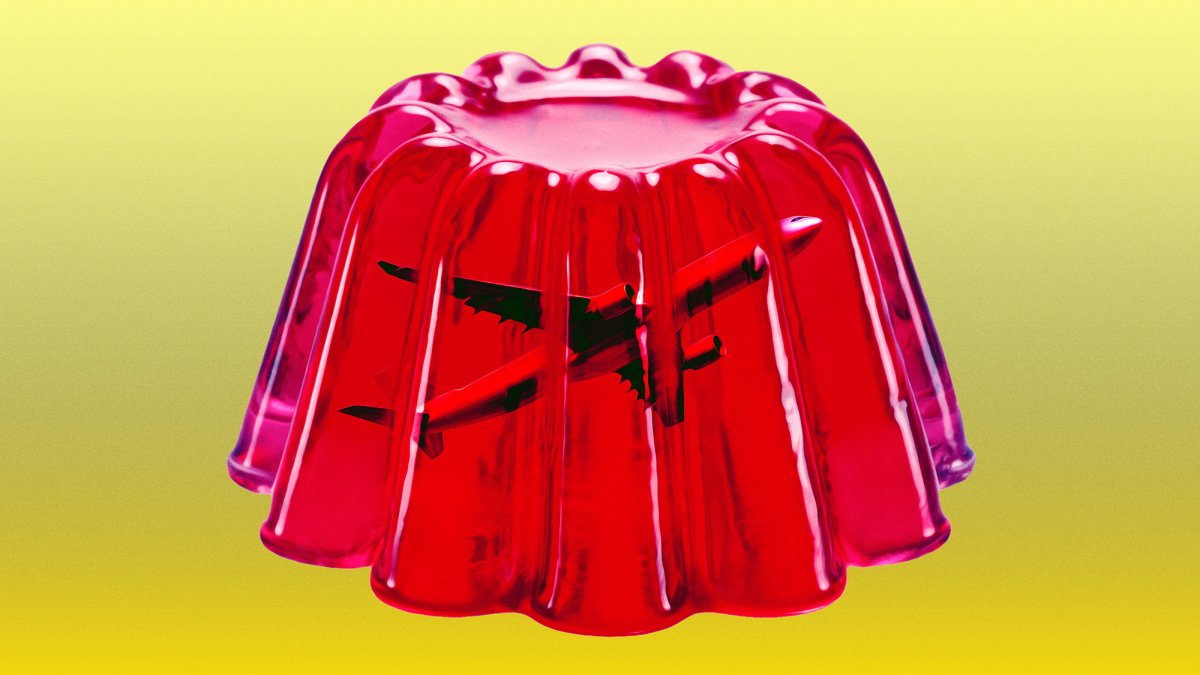
A young woman pushes a balled-up piece of napkin into a cup of Jell-O, asking the viewer to imagine that it is an airplane, high in the air.
“That is you flying through the sky,” she tells the camera. “There’s pressure from the bottom, pressure from the top, from the sides, pressure coming from everywhere.”
She taps the top of the Jell-O, making the suspended napkin ball quiver.
“This is what happens when there’s turbulence,” she says. “You feel the plane shaking, but [it] is not just going to fall down.”
The video is by Australian TikToker Anna Paul. Just days after she uploaded it in June 2022, it had accumulated more than 15 million views and thousands of comments from people saying it had cured their fear of flying. Paul says she got the tip “from a real pilot.”
But how accurate is the analogy? Is turbulence really like Jell-O?
The origins of the Jell-O analogy
The Jell-O analogy is the brainchild of former airline captain Tom Bunn, who is now a licensed therapist and founder of the SOAR program, which helps people overcome their fear of flying. Over years of listening to clients express their worries, Bunn realized that explaining the science of flight was often not enough to reassure people that flying was truly safe.
“Clients would say they look up in the sky and see a plane and it doesn’t look like it should be there,” he says. “It should fall because they don’t see anything holding it up.”
Because these nervous flyers lacked understanding of the forces holding a plane in the air, they would feel the jolts during turbulence and panic, imagining the plane was about to drop from the sky. To help them overcome this fear, Bunn looked for an analogy that would convince the emotional part of their brains that the plane was not going to fall.
He found it by asking them to recall the familiar sense of air resistance growing as speed increases.
“If you walk across the room, air doesn’t slow you down,” he says. However, “if you’re in a car and push forward with your hand out the window, it feels about the same as putting your hand in a swimming pool and pushing against the water.”
Appealing to this logic, Bunn would ask his clients to imagine the air getting thicker as the plane accelerated down the runway. By the time they were in the air, it was the consistency of Jell-O, supporting them on all sides.
Bunn acknowledges that the analogy is not completely accurate scientifically. But it is an emotionally resonant way of visualizing the forces that hold a plane up during flight.
“Technically, it involves Bernoulli’s theorem,” he says. “It has to do with the fact that the bottom of the wing is pretty much flat and the top is curved.”

The science that keeps planes flying
Daniel Bernoulli was an 18th-century Swiss mathematician and physicist who formulated several key concepts in fluid dynamics. The most famous is Bernoulli’s principle, which states that an increase in the speed of a fluid decreases the pressure exerted by the fluid.
In a river, for example, water speeds up as it passes through narrower sections. The water pressure is lower in these constricted areas, as the acceleration is caused by higher pressure behind the constriction than within it.
Air behaves much like a fluid. When it encounters an obstacle, it compresses or speeds up as it flows around the object in its path.
“When the plane runs into the air, the air that goes across the top of the wing has to catch up,” Bunn explains. Because of the curve on the wing’s top, the air “has to take a longer route, so the molecules spread out slightly. So, they don’t push as much on the top of the wing as on the bottom.”
As Paul says in her TikTok video, there is pressure coming from the air above and below the airplane. But the wing’s design means that the air pressure is greater below it than in the faster-moving air above it, pushing the wing upwards. This is the phenomenon known in aerodynamics as “lift.”
“The faster you go, the more powerful the Bernoulli effect,” Bunn explains. This is why, as a plane flies through the air at nearly 600 miles an hour, the pressure under the wings holds it in the sky as securely as a napkin ball in Jell-O.
Turbulence happens when blocks of air rub past each other at different temperatures, pressures or speeds. It can have many different causes, from thunderstorms to the centrifugal force of the earth’s rotation, which pushes bands of air outwards. Its strength ranges from mild, causing little more discomfort than a slight trembling, to severe, in which passengers or flight crew can be thrown around the cabin and risk injury if not wearing seatbelts.
Related ‘Ask Us Anything’ Stories
Turbulence is less scary than it feels
But while strong turbulence can feel alarming, Patrick Smith, a commercial pilot and writer of the Ask the Pilot blog, says that “people tend to have a very exaggerated sense of what the airplane is actually doing.”
“Airplanes have what we call positive stability,” he says. “When they’re disturbed from their position in space, by their nature they want to return to where they were.”
During turbulence, every jolt down is matched by an equivalent jolt up, holding the plane steady on its course—as if it were suspended in Jell-O.
“There has never been a plane crash from turbulence,” Paul says in her video. Is this true?
Bunn recalls one incident in the 1960s when a flight departing Japan’s Tokyo airport encountered severe turbulence off the side of Mount Fuji, causing it to suffer structural damage and crash into a forest. But, he emphasizes, such an incident would never happen today. For one, commercial jets would never fly so close to a mountain, knowing that these can disrupt air flows and cause strong forms of turbulence close to solid ground, where planes are naturally most vulnerable.
For another, improvements in airplane technology mean that planes are now much better constructed to withstand even the strongest forms of turbulence.
During testing of modern airliners, “you can almost bend the wing double [in half] and it won’t break,” Bunn says. In real situations, “you never see even a tenth that much wing flex.”
So, is turbulence really like Jell-O? Not exactly. But if you’re a nervous flyer, perhaps the image can help reassure you that the only real dangers from turbulence can be solved by simply wearing a seatbelt.
As Paul says: “You can just chill there. You’re just wriggling in jelly.”
In Ask Us Anything, Popular Science answers your most outlandish, mind-burning questions, from the everyday things you’ve always wondered to the bizarre things you never thought to ask. Have something you’ve always wanted to know? Ask us.

2025 PopSci Outdoor Gift Guide
Science,Ask Us Anything,Aviation,Technologyevergreen,Features,News#turbulence #JelloO #Pilots #weigh1768503719