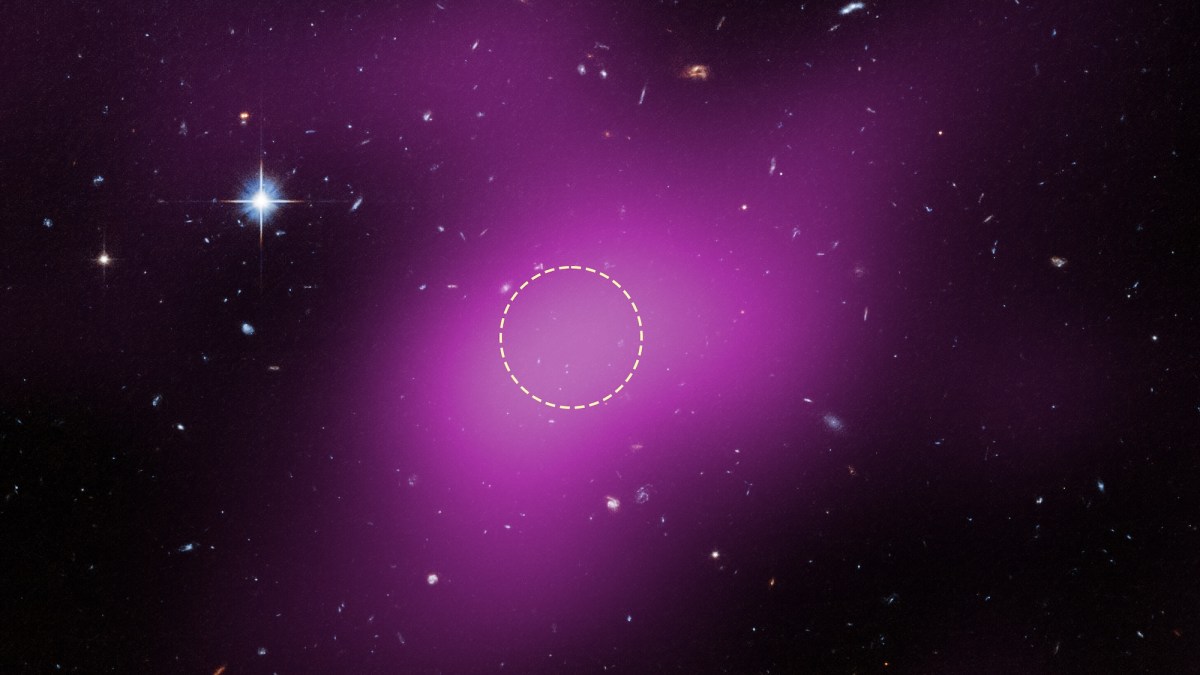
An international team of astronomers has discovered a new class of cosmic entity while harnessing the Hubble Space Telescope. Detailed in a recent study published in The Astrophysical Journal Letters, the find marks the first confirmed example of a long-theorized, but never proven formation known as a Reionization-Limited H I Cloud, or RELHIC. But while the gigantic region nicknamed Cloud-9 may be starless, it contains some of the universe’s most elusive content: dark matter.
“This cloud is a window into the dark Universe,” study co-author and Space Telescope Science Institute (STCScl) team member Andrew Fox said in a statement. “We know from theory that most of the mass in the Universe is expected to be dark matter, but it’s difficult to detect this dark material because it doesn’t emit light. Cloud-9 gives us a rare look at a dark-matter-dominated cloud.”
Located approximately 2,000 light-years from Earth, Cloud-9 is much smaller, symmetrical, and compact compared to the typical hydrogen clouds that neighbor the Milky Way galaxy. Initial calculations indicate the pressure of Cloud-9’s gas also balances the dark matter cloud’s gravity, implying it features much more of the latter. Currently, astronomers estimate it includes around 5 billion solar masses of dark matter.
According to Alejandro Benitez-Llambay, a program lead investigator and astronomer at Italy’s Milano-Bicocca University, Cloud-9 is the first-known RELHIC and a “tale of a failed galaxy.”
“In science, we usually learn more from the failures than from the successes,” he explained. “In this case, seeing no stars is what proves the theory right. It tells us that we have found in the local Universe a primordial building block of a galaxy that hasn’t formed.”
Two letters in RELHIC are key to understanding its significance—H and I. It stands for neutral hydrogen, the elemental gas from the universe’s earliest eras that never contributed to the birth of stars. Cloud-9’s core of neutral hydrogen is roughly 4,900 light-years wide and contains around 1 million times the mass of our sun.
For years, astronomers suspected that RELHICs lurked somewhere in the depths of space, but pinpointing them is a major challenge. What’s more, a suspected RELHIC could be overlooked without access to some of astronomy’s most powerful tools. In this case, the first clues about Cloud-9’s identity arrived in 2023, but it needed the Hubble Space Telescope’s Advanced Camera for Surveys to confirm its cosmic nature.
“Before we used Hubble, you could argue that this is a faint dwarf galaxy that we could not see with ground-based telescopes,” STScl astronomer and study co-author Gagandeep Anand explained. “They just didn’t go deep enough in sensitivity to uncover stars. But with Hubble…we’re able to nail down that there’s nothing there.”
However, Cloud-9 may not always remain a failed galaxy. Depending on its growth rate, the REHLIC may one day become massive enough to collapse and form the first stars in a new galactic neighborhood. At the same time, powerful cosmic forces may also strip away gas as Cloud-9 travels through space. Either way, astronomers now have their first REHLIC to study—and it likely won’t be their last.
“Among our galactic neighbors, there might be a few abandoned houses out there,” added study co-author and STScl astronomer Rachael Beaton.

2025 PopSci Outdoor Gift Guide
Science,Deep Space,NASA,Physics,Space,Space Telescope,TechnologyNews,stars#Mysterious #space #object #full #dark #matter1767724209