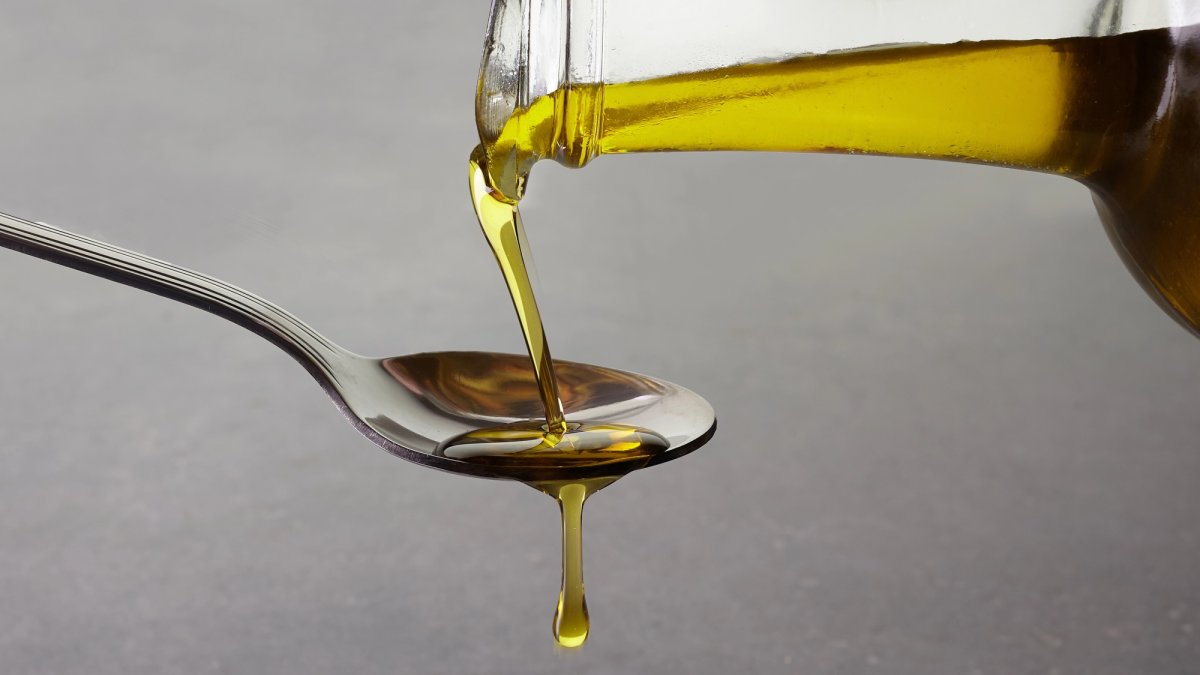
How much of your life is spent waiting for the last drops of syrup, olive oil, or even bodywash to drip from a container? This routine test of patience is owed entirely to complex fluid dynamics. But thanks to physicists at Brown University, people no longer have to guess how long it may take to finally empty that bottle of ketchup—provided you are well-versed in the right math.
According to Jay Tang and Thomas Dutta, co-authors of a study recently published in Physics of Fluids, you specifically need to know about Navier-Stokes equations. These formulas use conservation of mass principles to describe how fluids move based on Newton’s second law of motion (force equals mass times acceleration).
Tang typically focuses on the biophysics of bacteria, and how the organisms function and grow on wet surfaces. These relationships are much easier to study with everyday sources like kitchen liquids, however. Dutta recalled his grandmother always trying to force out the last drips from cartons and containers, while Tang had his own problems when cleaning his cast iron wok pan.
“In both cases, the relevant physics involves the flow of thin layers of fluid on a surface. This physics is everywhere in our regular research as well, so we decided that this would be a nice training exercise,” said Dutta.
The researchers focused specifically on what is known as the viscous regime in Navier-Stokes equations. These explain a liquid’s movement when it’s dictated by internal friction. Dutta used the equations to predict how long it takes fluids with different viscosities to progress along a downward angle. They then poured liquids like water, whole milk, clarified butter, and olive oil over a plate tilted at a 45 degree angle, weighing the liquids as they ran off the plate until 90 percent had left the surface.
The team’s theoretical calculations were largely supported by the results, and showed it’s all about the viscosity. Water reached the 90 percent mark in only a few seconds. Meanwhile, cold maple syrup could take hours to do the same. The physicists still learned a few new lessons in the process, however.
“I was surprised and actually a little disappointed. I usually wait only about one or two minutes, but it turns out that I need to be a lot more patient,” confessed Tang.
Tang often finishes a night’s kitchen cleaning by letting his wok sit for a moment on the counter. He never dries the pan with a cloth, because that would remove the oil seasoning. At the same time, he wants as little liquid to remain in the wok to decrease any chance of rusting. After a few minutes, he tilts the pan over the sink a second time to get as much out as possible. Based on both the study’s calculations and the experiments, it turns out Tang technically needs to wait as long as 15 minutes before doing the necessary second tilt.
While useful in the kitchen, the team’s equations go far beyond meal cleanup. Tang and Dutta can now employ these calculations to help further their research into bacterial dynamics.
“Besides the training side, this physics is everywhere in our main research. It just happens to also be the everyday fluid physics of the kitchen,” said Tang.

2025 PopSci Best of What’s New
Science,Physicsculture,fluid dynamics,News#Physicists #calculate #long #drop #takes1772731414

Recent Post



Gallery





Featured Videos