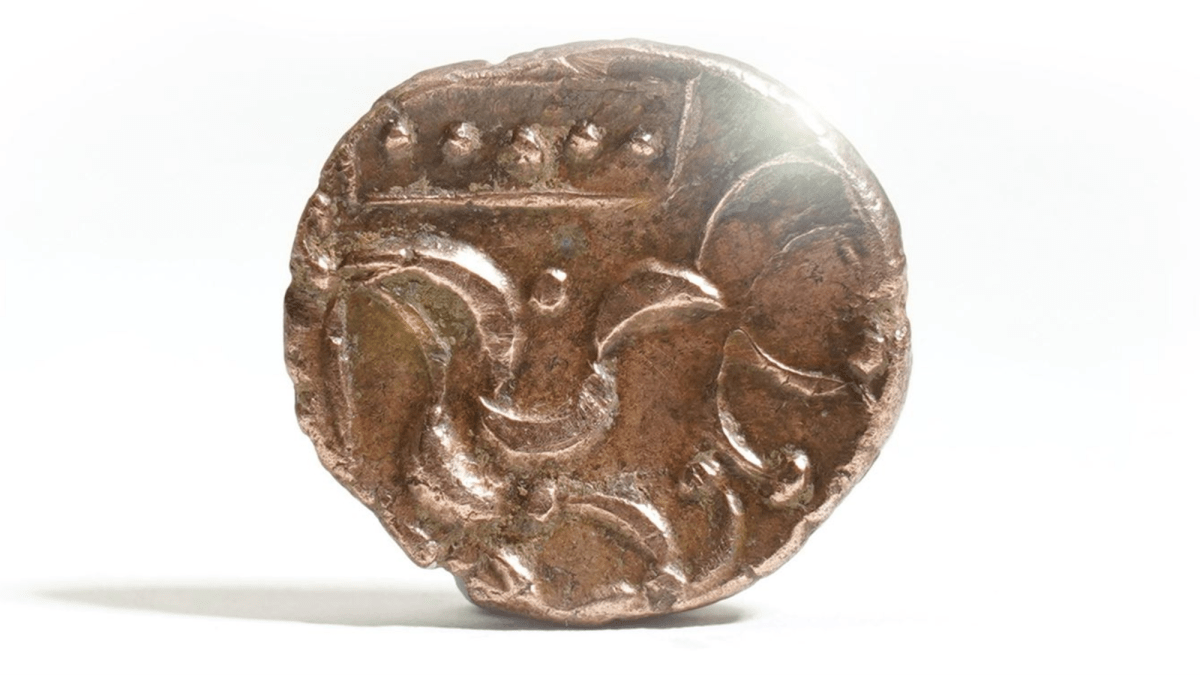
An ancient Celtic coin discovered in a field in northeast England could fetch over $5,000. A metal detectorist in Lelley, East Yorkshire, discovered the gold coin that dates back to about 50 to 10 BCE (during the Iron Age).
According to David Duggleby Auctioneers in Scarborough, the coin is a variant of a Corieltauvi tribe gold stater. These types of coins were made by the Celtic Corieltauvi tribe that held much of the East Midlands, including all of present-day Lincolnshire, stretching north to one bank of the River Humber.
The city of Leicester operated as the Corieltauvi tribe’s Roman capital, and included a mint where these coins were struck. However, this particular gold coin was found further north in an area that was once the territory of a different tribe—the Parisi. This smaller group once occupied an area in present-day East Yorkshire. Auctioneers believe that this indicates evidence of trade between the Corieltauvi and Parisi, as the tribes were “apparently pretty civilised.” Discoveries like this one can help illuminate how objects and ideas spread across tribal boundaries long before the Romans ruled the island.

The coin is the second known of its kind and considered a stater—an ancient coin commonly found in Greece. It weighs less than one ounce and is made up of 33 percent gold, 54 percent copper, and 9.5 percent silver. It has five dots on it and an illustration of a horse below the dots. That extra dot—also called a pellet or domino—is what makes the coin so rare and could even double its value at auction.
“It is the fifth pellet on this coin that makes it so incredibly rare,” Auctioneer Coralie Thomson told the BBC. “Corieltauvi staters always had four pellets–or so everyone thought until a five-domino variant was unearthed in Northamptonshire last year.”
The exciting find will be part of the Coins, Banknotes & Stamps auction on Thursday, January 8. It has a pre-sale estimate of £2,000 to £4,000 (about $2,698 to $5,396). The auction house expects “lively bidding,” as interest in this coin is already pouring in. This particular auction also includes a Queen Elizabeth II 1989 gold proof Britannia four-coin set, silver coins stretching back to the Medieval and Tudor periods, as well as bronze Celtic, Viking, Anglo-Saxon, and Roman coins.

2025 PopSci Outdoor Gift Guide
Science,ArchaeologyNews#Rare #Celtic #coin #metal #detectorist1767797714