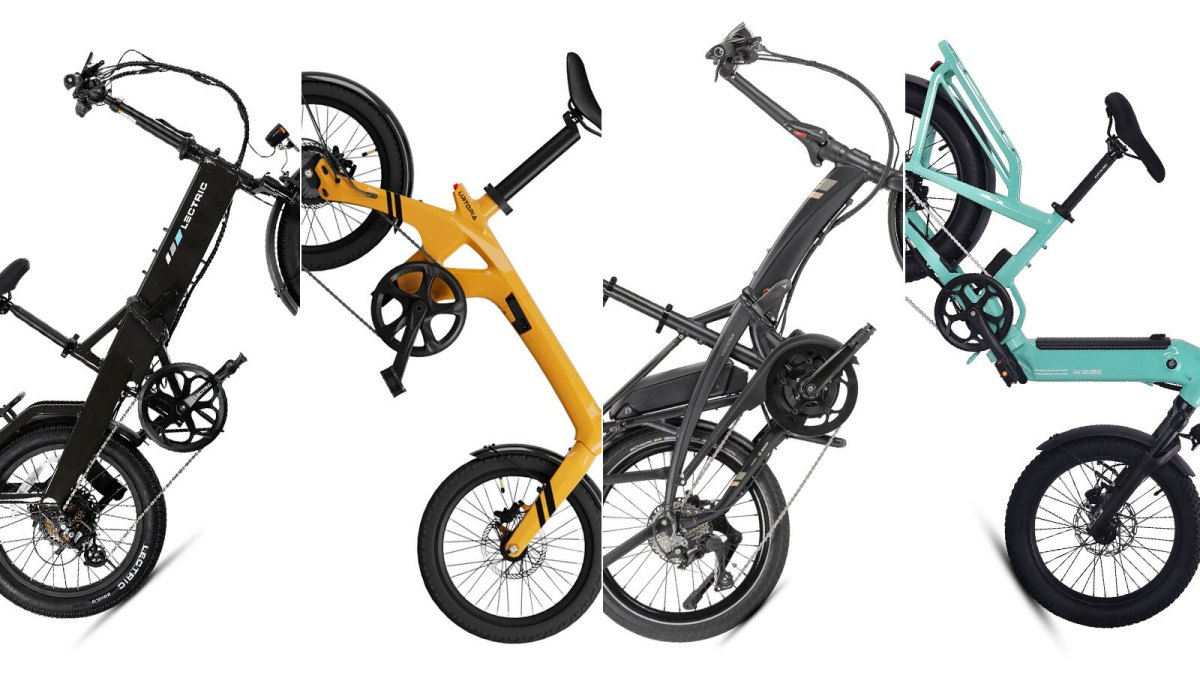
All sorts of interesting one- and two-wheeled vehicles crisscross my city streets, including an increasing number of affordable, portable forms of tech-packed personal transportation . Spandex-clad cyclists take advantage of protected lanes, while electric scooters zip over sidewalks (and anywhere else). Occasionally, an odd unicyclist or one-wheeler breaks up the predictability. I particularly like to watch foldable e-bike riders who go from trail to train, transforming their personal transit into a cube to carry through a crowd. These now-you-see-it, now-you-don’t collapsible electric bikes offer power assistance for commuting or errands without taking up valuable real estate in an apartment or townhouse. These flexible options can often fit into an SUV or RV for extended outdoor adventures without the need for a heavy-duty, and often expensive, rack. We’ve updated the most reliable options—like our best overall, the Lectric XP4—so you can find the best folding electric bikes to match your riding style and needs.
How we selected the best folding electric bikes
We don’t test these bikes in a lab—we take them out into the wild. That means folding and unfolding them on sidewalks, rolling them into elevators to see if they actually fit, and lifting them into car trunks to find out if it’s a one-person job or a two-person struggle. We ride the same loops we’d take to work or the store—complete with potholes, stoplights, sketchy shoulders, and plenty of zippy scooters.
Every bike gets pushed on performance: full pedal assist, lights on, up and down hills until the battery taps out. We pay attention to what it’s like to live with the thing—how it rides, how it folds, and whether we’d actually want to use it every day.
The best folding electric bikes: Reviews & Recommendations
Folding e-bikes are all about space efficiency, but what that looks like depends on the rider and what accessories you might want to carry. If you’re an urban commuter navigating a cramped apartment, crowded train platforms, and zero bike parking, you want something that folds fast, rolls easy, and doesn’t make enemies in the elevator. On the flip side, RVers, van-lifers, or campers may want a more rugged ride with enough power and range to cruise trails, run errands, or sub in for a car when you’re off-grid.
All folding e-bikes promise one thing: they take up less space when you’re not riding them. Most have shorter wheelbases, lower standover heights thanks to smaller diameter wheels, and upright riding positions that keep you visible in traffic and balanced at low speeds. But the real magic is in the fold, whether that’s a single hinge or a multi-jointed origami routine. If you’re just tucking it into a hallway or closet, weight might not be a dealbreaker. But if you’re hauling it into a trunk or up a flight of stairs, make sure it’s something you can lift without needing an ice pack after.
If you’re used to riding full-sized bikes, folding e-bikes do take some getting used to (as do all e-bikes). Taller riders might feel like they’re perched on a circus act, while smaller riders often find the compact fit more confidence-inspiring. The sharper turning radius is a win in tight spaces, but some gearing setups can leave you spinning without much payoff. Ride a few miles, though, and most people settle into the rhythm quickly.
Best overall: Lectric XP4
See It
Pros
- Front oil suspension fork
- Rear rack that can hold up to 150 pounds
- Five levels of pedal assist plus throttle
- Front and rear 602 hydraulic brakes
- Integrated headlights and rear lights
- Front and rear fenders
- Removable battery
- External charging port
- Slime-lined tires to prevent flats
- Multiple mounting points for additional accessories
- 1-year warranty
Cons
- Long-range battery available for extra
- Well-organized, but external wires and cords
- Nothing to secure the bike when folded
Specs
-
Unfolded bike:
66 inches long by 18.5 inches wide by 45 inches tall -
Folded bike:
37 inches by 17 inches wide by 29 inches tall -
Motor:
500W hub motor with 55Nm of torque (750W option available) -
Battery:
672Wh lithium-ion -
Riding range:
Up to 50 miles using pedal assist or up to 20 using throttle only (Long-range 85-mile version available) -
Class:
1, 2, or 3 -
Top speed:
28 mph -
Bike weight:
62 pounds without battery (7 lbs.) -
Carrying capacity:
330 pounds (combining rider and passenger/cargo)
Lectric is one of the OGs of foldable electric bikes, so much so that I’d nearly always get a shout or recognition from another Lectric rider when I was riding one around town. They’d chat with me at a stop or ride alongside me for a bit, and I can honestly say it’s never happened to me on another brand of e-bike. The Lectric XP4 finetunes what it’s learned from previous models for an affordable, fun ride with five pedal-assist levels and a thumb throttle. Lectric added more juice to the 500W motor, which can peak at 1,092W and kick out 55Nm of torque.
The tires are fat-tire lite—20 by 3 inches with custom tread—which makes for a more cushioned ride with the front suspension fork. The improved Shimano Altus gearing and an in-house-designed torque sensor mean less furious pedaling than other models to get up to top speeds. Lectric lists the standard step-over at $1,300 (there are also step-thru and long-range variations), but you can often find it on sale for a grand—and yet, it still has hydraulic brakes, which are a rarity at this price point. The XP4 also comes stock with many nice commuter extras, like integrated lights, front and rear fenders, and a monster rear rack that can hold up to 150 pounds. Lectric offers a ton of accessories, including a passenger seat for light riders (e.g., kids). It now features a TFT LCD color display with a USB-C charging port.
For most people, the Lectric will meet their folding e-bike needs, but it’s not perfect. Lectric, more than many brands, makes you well aware of cords. While the wiring up front is well-organized, nothing is internally threaded. It folds at two points—at mid-frame and the handlebars—and it frankly takes some practice to align pedals, handlebars, and wheels just right. You’ll also need a bungee cord (or something similar) to keep everything nice and tight if you want to move the bike while folded (see below). But it does get small enough to go into a typical car trunk—not a Miata, let’s not get crazy. It is, however, a heavy 62 pounds (69 unless you scrap the battery).

Best for urban and multimodal commuters: Brompton Electric G Line
See It
Pros
- One of the most compact folding bikes
- Equipped for commuting with integrated front and rear lights, fenders with mudflaps, rear rack, and a bell
- Balance and handling like a full-size bike
- Removable battery pack for easy charging or secure storage
- Excellent for multi-modal commuters
- Comes in three frame sizes to fit riders from 5’ to 6’6”
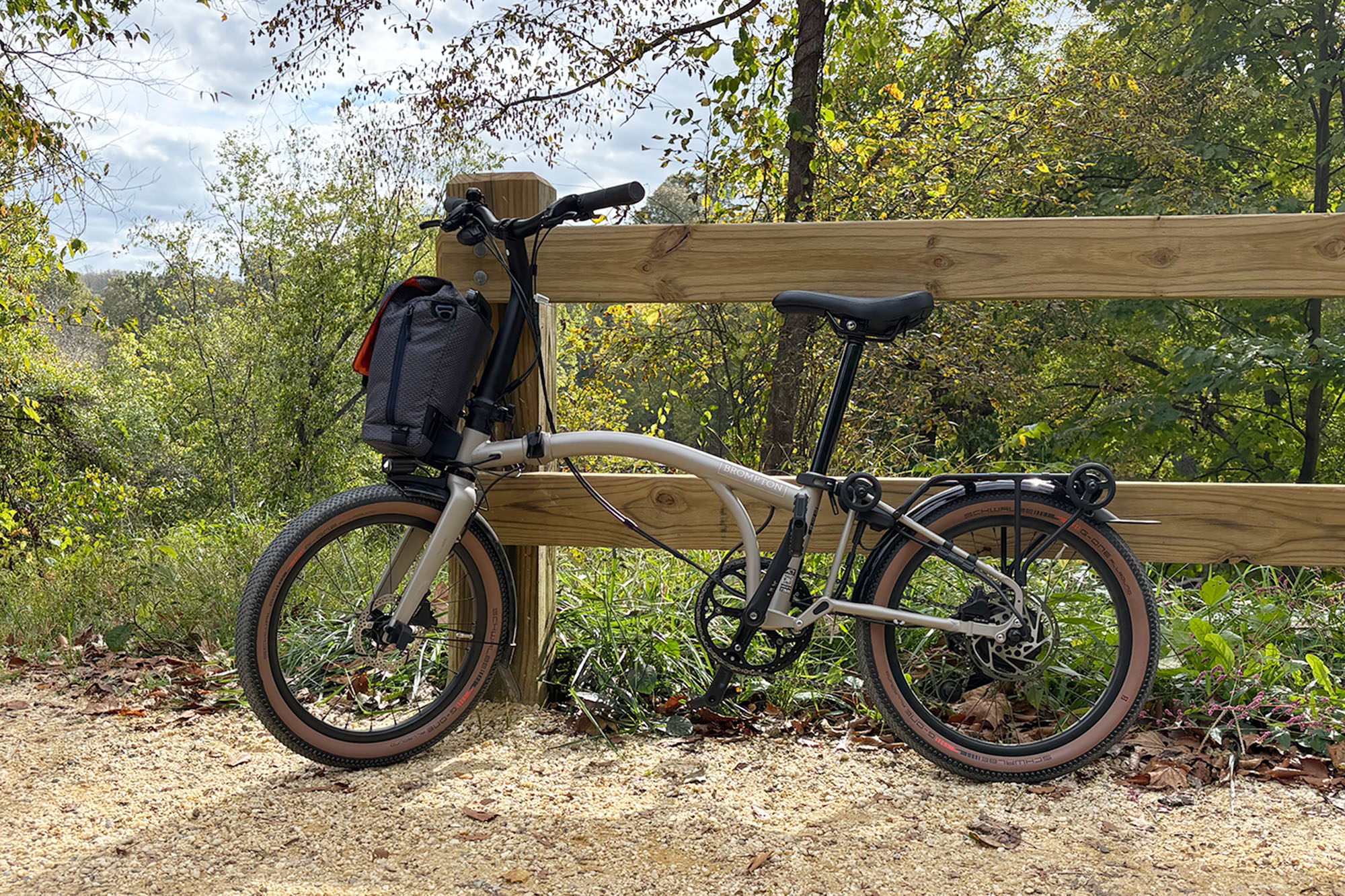
- Available in three colors: adventure orange, forest green, traildust white (shown)
- Optional app
Cons
- Rocker-style display controls for PAS aren’t immediately intuitive
- Larger wheels mean folding takes more practice
- No throttle and no suspension, so plan to pedal and expect vibration on rougher roads
- Pricey for casual commuters
Specs
-
Folded size:
28.3 inches deep × 26.2 inches tall × 16 inches wide -
Motor:
250W rear-hub motor -
Battery:
345Wh capacity, charges to 100% in 4-5 hours -
Removeable battery:
Yes (housed in front-mounted bag) -
Compliance:
UL 2849 certified -
Riding range:
20 to 45 miles -
Class:
1 -
Top assisted speed:
20 mph -
Throttle:
No -
Drivetrain:
4-speed -
Brakes:
Tektro hydraulic disc -
Tires:
20-inch Schwalbe G-One Allround 54-406 tan wall -
Bike weight:
About 43 pounds w/ battery bag (35 lbs. bike only) -
Connectivity:
Brompton Electric app (iOS and Android)
The Brompton Electric G Line doesn’t look like your average e-bike—and that’s the point. This is the electrified version of Brompton’s iconic folding bike, designed for people who need a compact ride that’s easy to stash indoors or carry onto public transit. It folds down smaller than anything else in this roundup, and hides its motor and battery inside a clever front-mounted bag that clicks on and off the frame. It’s a refined solution for riders who live in apartments, juggle multi-leg commutes, or just don’t have a safe spot to lock up a full-sized bike.
At about 43 pounds, the Electric G Line is heavy for Brompton but very light for an e-bike, especially a folding one. Its signature tri-fold is among the fastest folding bikes: pivot the rear wheel under, collapse the main frame, and fold down the handlebars. The whole process only takes a couple of minutes, and the rear rack has wheels that let you roll the folded bike rather than lug it around. Skilled unfolders can kinda flick the bike open, but my short stature never got the hang of it—or it could be the G Line’s larger 20-inch wheels. Still, for people who go from bike ride to subway, the whole package rolls easily through a station and can slide under a desk once you get to an office.
Despite its small size and quirky looks, the G Line rides like a much bigger bike. The 250W rear hub motor is quiet and natural-feeling, giving a smooth assist that enhances your pedaling without ever lurching forward. It’s paired with a 345Wh battery and a four-speed drivetrain that shifts cleanly—even if you might wish for an extra gear when really pushing. The high-volume Schwalbe tires soak up most road chatter, and the stretched frame geometry gives it a stable, planted feel. On paved streets and smooth trails, it feels confident and composed. Gravel is more of a backup plan; the G Line can handle light dirt or hardpack, but without suspension, rougher terrain sends vibration straight to your hands.
The cockpit is minimal, and that can be a blessing or a quirk depending on your style. The small color display looks great, and you change pedal assist level by rocking the screen up or down. However, so many control units use physical buttons or touchscreens that this movement isn’t necessarily intuitive. You can also change assist levels from the battery bag or via the Brompton app, but neither is a fast mid-ride adjustment. On a full battery with max assist, it delivered over 27 miles of city and trail riding in testing, and it steps down its support gradually as the battery drains. Even fully unpowered, the bike is easy to ride thanks to its well-balanced frame and drivetrain.
The G Line isn’t a casual purchase—it starts around $4,950—but it’s not built for casual needs. It’s a splurge for riders who want the convenience of a folding bike with the ride feel of something much larger, and who plan to use it as part of everyday life. If your bike lives inside with you, travels on trains, or gets folded twice a day, this one earns its keep. As we explained in our full review, the G Line makes few compromises for something this compact, and still manages to be fun, functional, and unexpectedly fast.
Best for off-road adventures: HeyBike Mars 3.0
See It
Pros
- 750 W (1,400 W peak) motor with serious torque
- Full suspension and fat tires for comfort and traction
- Multiple security layers: NFC cards, PIN, app, and key
- High-capacity battery for longer ranges
- Comes with built-in electronic horn, brake lights, and turn signals
- Comes in three colors: orange, blue and black
Cons
- Stiff center hinge can make removing the battery or folding a two-person affair
- Dynamic battery gauge can be hard to predict
- Hard to secure to a bike rack without a long, flexible chain
- It folds, but it still requires larger vehicles for transport
- It’s easy to forget the key required for riding
Specs
-
Folded size
38.2 inches tall x 19.7 inches wide x 33.1 inches deep -
Motor
750 W (1,400 W peak) rear hub with 95 Nm torque -
Battery
624 Wh -
Removable
Yes, lockable -
Compliance
UL 2849 -
Range
Up to 65 miles -
Class
Ships as Class 2, can be changed to 1 or 3 -
Top speed
Unlock up to 30 mph -
Throttle
Yes -
Tires
20″ × 4″ fat tires -
Suspension
Front hydraulic fork with 65mm travel and rear Horst-link -
Drivetrain
Shimano Altus 8-speed -
Weight
about 70 lb -
Frame size
One, fits riders from 4’11” to 6’2” -
Connectivity
HeyBike app
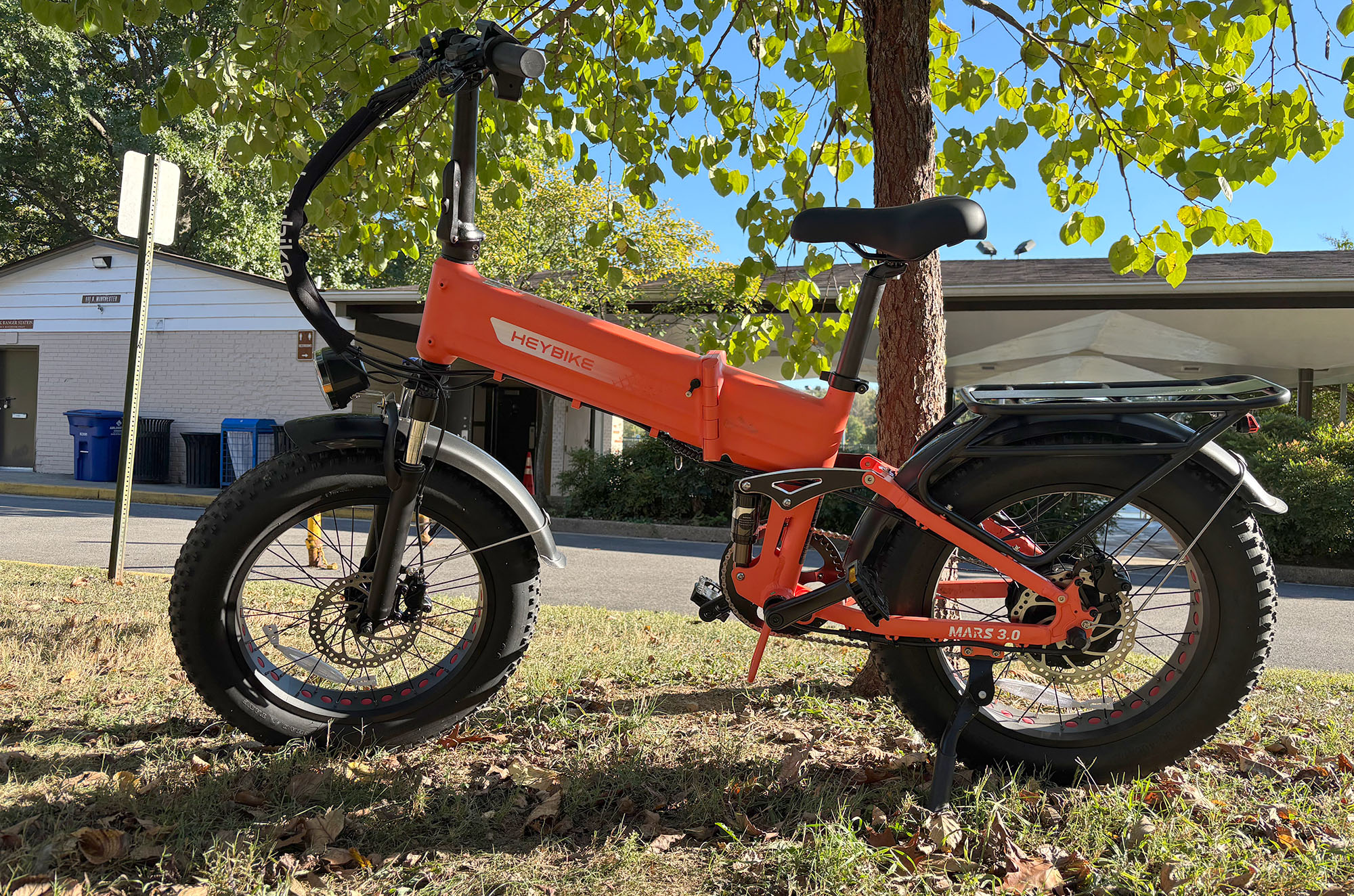
The Heybike Mars 3.0 is built for weekend wanderers, RV adventurers, and anyone who’d rather be bouncing down a trail than weaving through traffic. With 4-inch fat tires and full suspension, it turns cracked pavement and chunky gravel into something closer to a suggestion than a challenge. It’s less about fitting into tight spaces and more about blasting out into wide-open ones.
Twist the throttle or tap the pedals, and the Mars 3.0 surges forward like it’s been waiting for a greenlight at a race track. In Eco mode, pedaling feels effortless, and hills practically vanish. Kick it into Boost, and pedaling becomes optional. The plush suspension softens every hit, giving even rough trails a floaty, playful vibe. It’s the kind of ride that makes you seek out the bumpy route just for the fun of it.
Yes, it folds, but you’ll need to mean it. At around 70 pounds, the Mars 3.0 is hefty, and the folding process—collapsing the frame and dropping the handlebars—is made trickier by its bulk and a center hinge that started out pretty stiff. There’s a built-in stand to keep stress off the drivetrain, but lifting it into a car is a two-person job for most people. It fit in a hatchback, barely, and would be more at home rolling into an RV or the back of a pickup.
You’ll also need to keep track of the required key, and in fact, the Mars 3.0 features a multilayered security system that lets you choose between unlocking the bike with the app, PIN code, or NFC card. It feels like overkill until you remember this bike is basically a joyride machine, and Heybike clearly doesn’t want it rolling away without you.
If you think of folding as a way to bring your bike to the trail—not necessarily store it under your desk—this one makes a strong case. As we explained in our full review, the Mars 3.0 trades sleekness for capability, and for the right kind of rider, that’s exactly the point.
Best for long-range rides: Velotric Fold 1 Plus
See It
Pros
- Option to switch between torque and cadence sensors
- Speed customization available
- Fully equipped for commuting with fenders, rear rack, 130 lux front light with adjustable angle, and rear brake light with turn signals
- Comfy ride with front suspension and cushy saddle
- Long-range and powerful 750W motor
- Telescoping handlebars
- Simple, company fold with stand to keep from putting weight on delicate components
- USB-C plug for phone charging
- Integrated Apple Find My
- Velotric app connectivity
- Comes in four colors: Mango, Electric Blue (the model tested), Stone Gray, and Pearl White
Cons
- May not fit easily in standard car trunks
- Battery can be a little tricky to slide in and out of the frame
- Folding pedals feel unintuitive at first
- Motor gets noticeably louder on higher mode and assist combos
- Not for subway/train commuters
Specs
-
Folded bike:
37.8 inches long x 19.7 inches wide x 33.5 inches high -
Motor:
750W (up to 1,100 W peak) rear hub -
Battery:
624Wh, IPX7 and UL 2271 Certified -
Riding range:
Up to 68 miles (pedal assist), up to 45 miles (throttle only) -
Class:
1, 2, or 3 (adjustable) -
Top speed:
28 mph (adjustable) -
Bike weight:
63 pounds -
Carrying capacity:
450 pounds total (up to 120 pounds on rear rack)
The Velotric Fold 1 Plus answers the question, “Can a bike be chill and still haul?” with a confident yep. Its 750W rear hub motor (1,100W peak) rockets you off the line, while a 624Wh battery delivers an eyebrow-raising 68 miles on pedal assist. That’s “all-day adventure” territory—without the sore legs.
One size really does fit all here (as our full review reveals): the ultra-low step-through frame welcomes riders from 4’9” to 6’5” and keeps cargo (up to 120 pounds on the rear rack) stable and steady. The ride is pure cush—front suspension, plush saddle, upright stance, and chunky 20×3-inch puncture-resistant tires soak up bumps so you can focus on grinning.
Commuter cred? Fully earned. Full fenders, a 130-lux aimable headlight, brake-activated rear light with turn signals, hydraulic disc brakes, and even a USB-C port to juice your phone mid-ride. It folds to 37.8 x 19.7 x 33.5 inches—compact enough for SUVs and RVs—while a built-in stand and velcro strap keep the package neat. Though it would be bulky if you’re trying to go from trail to train.
Here’s the kicker: you can tune it to your mood. Swap between torque and cadence sensors, tweak top speed up to 28 mph (or dial it down for the kids), and track every ride through the Velotric app—with Apple Find My as your digital safety net.
Fast, comfy, and ridiculously versatile, the Fold 1 Plus isn’t just a folding bike—it’s your ticket to go farther, faster, and have more fun doing it. A do-it-all folder for riders of almost any size, this e-bike aims to (and mostly does) fit nearly everyone’s needs.

Best lightweight: Urtopia Carbon Fold 1
See It
Pros
- Carbon fiber frame means exceptionally lightweight
- No assembly required
- Colorful, crisp display
- Short wheelbase means nimble handling
- Nice large chainring means it doesn’t feel like you’re peddling furiously
- Hydraulic disc brakes
- Integrated headlight/tailight
- Front and rear fenders
- Removable battery clearly placed in seat post
- Very fast two-step fold, with magnetic fasteners to keep things compact during transport
- Latches feel rigid and secure when in play
Cons
- Carbon fiber isn’t cheap
- Max range may be more optimistic than realistic
- Carbon fiber absorbs a fair amount of road, but it can’t replace the comfort of actual suspension
Specs
-
Folded bike:
800 mm x 680mm -
Motor:
500W peak rear hub motor w/ 42Nm torque -
Battery:
252Wh lithium-ion -
Riding range:
Up to 40 miles -
Class:
2 -
Top speed:
20 mph -
Bike weight:
29 pounds -
Maximum rider weight:
220 pounds
The Urtopia Carbon Fold 1 is a shockingly delightful but diminutive Shimano Altus 8-speed commuter that folds up fast and rides even faster. Thanks to its brightly painted carbon fiber frame and fork (the company’s signature material, Saffron Yellow colorway shown above), this bike weighs just 29 pounds. That makes it light enough to toss into small car trunks or an RV for road trips, camping, or other overlanding adventures. And makes it a dream if you live in a multi-story walkup and/or need to factor subway rides into your commute. Despite its compact build (which arrives fully assembled), it can support riders from 5’1’’ to 6’1’’ and up to 220 pounds in total weight, though taller or long-legged riders may feel somewhat cramped.
Little details make a big difference: Built-in magnets keep the bike securely folded while you move it around—no awkward flopping. Heavy-duty latches lock it back into riding position. Cable management is clean. A central cutout serves as a handle and place to thread your chain, so no one can fold the bike off its lock.
Out on the road, the 500W peak rear hub motor and 42Nm of torque provide quick, zippy acceleration, allowing you to reach speeds of up to 20mph. Its low standover height makes it super-easy for frequent stopping and standing during city rides. It also has a short wheelbase, making it excessively nimble—great for dodging cars illegally parked in the bike lane and weaving through potholes, cones, or people staring at their phones. Plus, the TEKTRO hydraulic disc brakes are responsive. It’s surprisingly fun for something whose main function is to be practical.
The 252Wh battery is cleverly hidden in the seat post (which can be fully removed for charging/storing … or to deter thieves, because a bike with no seat is just an extremely inconvenient scooter). It powers the motor, but also the color screen and integrated headlight/taillight. It feels like it’s designed for several short jaunts rather than significant mileage; however, as the published 40-mile range seems optimistic, especially on assist levels above Eco (Touring mode felt closer to the 20s).
My version two wishlist includes a more sensitive torque sensor and a bigger battery, but for anyone short on space—or anyone who wants a travel bike without messing with a rack—the Carbon Fold is a blast. The Carbon Fold 1’s recommended retail price is $2,500, but it has been consistently on sale for $1,600.

Best value: Ride1Up Portola
See It
Pros
- Five pedal assist modes plus throttle
- Front suspension fork
- Dual-piston hydraulic brakes
- Front and back fenders
- Rear rack holds up to 130 pounds
- Integrated front and rear bikes
- Folding pedals
- Chainguard stay
- Short velcro strap to hold the bike together when folded
- 1-year warranty
Cons
- Long-range battery available for extra
- Well-organized, but external wires and cords
- Taller riders may find leg extension lacking
Specs
-
Unfolded bike:
66.2 inches long by 19 inches wide by 44.4 inches tall -
Folded bike:
33 inches long by 19 inches wide by 29.5 inches tall -
Motor:
750W geared hub motor with 65Nm torque -
Battery:
500Wh -
Riding range:
Up to 40 miles -
Class:
Switchable to 1, 2 or 3 -
Top speed:
28 mph -
Bike weight:
59 pounds -
Carrying capacity:
300 pounds
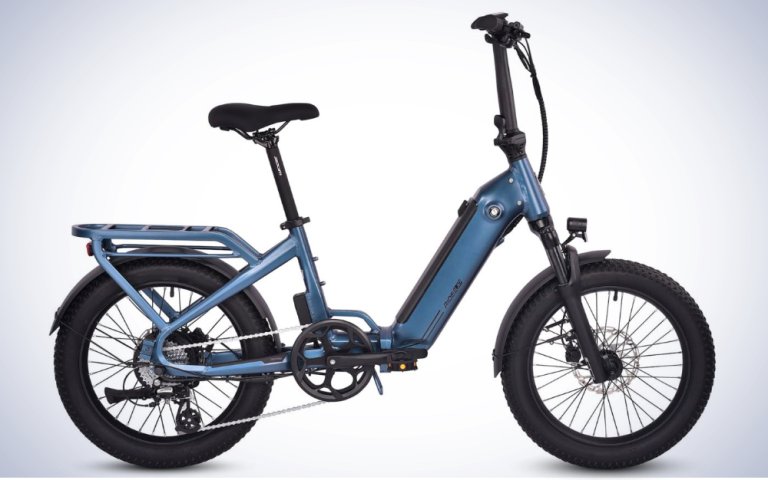
The Ride1Up Portola has a big ol’ motor—750W, the largest of this roundup. It also features a front suspension fork, 8-speed drivetrain, hydraulic brakes, and a muscular welded rear rack that can hold up to 130 pounds. These details are surprising to find on a folding e-bike and downright shocking to find on one that costs less than a grand.
The Portola offers a lot to like, especially at the price point. Sturdy 20-inch by 3-inch tires and a front suspension fork work together to keep the rider relatively comfortable. There’s only one frame size, which Ride1Up calls “one size fits most,” or in this case, means riders from 4’10” to 6’4”—though taller riders or long-legged ones note they’d like a little more extension when they pedal.
The Portola initially starts with a 10.4Ah battery, but an upgrade to 13.4Ah is only $100 more. With five pedal-assist levels and a throttle, you might want the extra juice. The range is up to 40—or 45 with the larger battery. The e-bike also can be switched between Class 1, 2, or 3, depending on whether you want to limit or unleash a potential top speed of 28 mph. And here’s one very simple but very nice touch that many folding bike makers overlook: The Portola has a small velcro strap to secure the bike when it’s folded. It takes some fussing to get the wheels and handlebars just right, but folding bike owners frequently add their own bungees or straps because nothing was included.
What to consider when searching for the best folding electric bikes
Usually, a search for an e-bike begins with sticker shock, especially if you don’t ride other bicycles. You can find budget electric bikes under $1,000, though models quickly get into the multiple thousands. Expect to find more powerful motors with more torque, larger batteries, and frames made of higher-quality, often lighter-weight materials as the price climbs. They’re like cars: You can find a reasonably priced, reliable model or spend serious bucks on high-end components, luxury features, and eye-grabbing designs. While the options may be daunting, there is a model out there to suit your tastes and budget, whether you’re looking for the best electric commuter bike or the best fat tire electric bike.
It’s also worth checking whether your state offers tax credits or rebates for e-bikes to encourage adoption.
E-bike classes: What they mean for folding bikes
E-bike classes help define how fast your bike can go with motor assist and where you’re legally allowed to ride. This matters a lot if you plan to ride on bike paths, public trails, or shared-use routes. However, the rules will vary from state to state and from locality to locality. Before buying, check your local laws because some states treat e-bikes like regular bikes, while others (like Alaska and New Mexico) regulate them more like mopeds. (Check out the non-profit advocacy group People for Bikes’ guide for state laws.)
To make this even muddier, many e-bikes allow the owners to change classes through the display or an app. This is usually called “unlocking,” but it’s a simple setting that lets you set a top speed of 20 or 28 miles per hour. Similarly, some e-bikes have throttles that can be enabled, disabled, or totally removed.
| Class | How it works | Assist limit | What it means for you |
| Class 1 | Pedal-assist motor only | Stops assisting at 20 mph | Usually allowed on bike paths and trails |
| Class 2 | Throttle and pedal assist | Stops assisting at 20 mph | Throttle use may be restricted in some areas |
| Class 3 | Pedal-assist motor only | Stops assisting at 28 mph | Sometimes banned from shared-use paths and may have age and/or helmet rules |
Hub motor vs. mid-drive: What’s the difference?
Most folding e-bikes use hub motors, usually built into the rear wheel. They’re simple, affordable, and beginner-friendly. The power comes on smoothly—more like a steady push than a sudden surge—which makes them great for casual riders or flat city commutes.
Mid-drive motors, which sit at the cranks, are more efficient and offer better torque for climbing hills or hauling loads. They feel more like traditional cycling because they work with your gears. You’ll find them less often on folding bikes due to their cost and complexity, but if you do, it’s a premium upgrade.
Motor power is usually measured in watts, ranging from 250W to the legal U.S. max of 750W. More watts can mean more speed and stronger acceleration, but torque is what really helps with hill climbs and quick takeoffs. If you’re in a hilly area or want zippier starts, look for motors with high torque ratings.
Batteries: Range, charging, and what really matters
Range is one of those features e-bike makers love to hype—and it’s getting better all the time. These days, even folding models often boast 60, 70, or even 85 miles on a single charge without needing a second battery. But actually hitting those numbers? That depends.
Published ranges usually list a minimum and a maximum, and the real-world number lives somewhere in between. Terrain, rider weight, cargo, temperature, tire pressure, and how hard you push the motor (pedal assist vs. throttle, low vs. max level) all make a difference. For example, my commute in the summer takes a quarter of my fully charged battery, but in extreme headwinds or freezing temps, it can easily eat up more than half of my battery. Same ride, same battery, different conditions. If your planned ride is 15 miles round-trip, don’t buy a bike with a 15-mile max and hope for the best—get something with some buffer.
Removable batteries are especially helpful for folding bikes. You can charge them inside, swap in a spare for long rides, or remove them for storage. Integrated batteries keep things sleek and tamper-resistant, but mean bringing the whole bike to an outlet. Bigger batteries weigh more, but they also give you more flexibility and less range anxiety.
One last thing: battery safety isn’t optional. Look for certifications like UL 2849 (entire system), UL 2271 (battery only), or EN 15194 (European standard). These show that the battery’s been tested against overheating, impact, and general misuse.
FAQs
Q: What are the downsides of folding electric bikes?
Folding e-bikes can be game-changers for commuters, but they come with a few trade-offs. They’re usually more expensive than non-electric bikes and heavier than standard folders. You’ll also need a place to charge—or look for a model with a removable battery you can charge indoors. Over time, batteries degrade and need to be replaced. And while most bike shops can service standard parts, proprietary systems or wiring may need brand-specific help. Folding frames also introduce additional wear points, such as hinges, latches, and clamps, which may loosen over time and with repeated use.
Q: Can folding e-bikes go long distances?
Yes. Many folding e-bikes advertise up to 40 to 80 miles of range, but real-world numbers depend on terrain, assist level, rider and cargo weight, and weather. If you ride mostly flat roads on low assist, your battery will stretch much farther than if you’re using throttle up steep hills. As for comfort, smaller wheels and minimal suspension mean you’ll feel more of the road, so “long distance” might come with more bumps.
Q: How much do folding electric bikes weigh?
Folding e-bikes generally weigh between 35 and 70 pounds. Lighter models made with carbon fiber or smaller motors can dip below 35, while more powerful or accessory-loaded models hit the upper end. They’re still easier to maneuver than traditional e-bikes thanks to their compact shape and smaller wheels—but lifting one into a trunk or up stairs? That’s where the real test comes in.
Q: Are folding e-bikes allowed on trains and buses?
In most cities, yes. Transit systems usually allow folding bikes on board, especially if they’re compact and folded before boarding. Just be prepared to carry or roll it quickly, and avoid peak commute times if the bike takes up space. Always check local transit rules—some systems restrict e-bikes by weight, battery size, or class.
Final thoughts on the best folding electric bikes
Folding electric bikes are a funny sort of transportation. They’re purpose-built to be easy to transport or store, which may mean some compromises in riding comfort. However, this category of bikes has come a long way, incorporating fatter tires, more suspension systems, and hydraulic brakes for superior stopping power, along with more options than ever before. Find the model that fits—literally—into your apartment, car, or commute, and enjoy the ride.

2025 PopSci Outdoor Gift Guide
Gear,Outdoor GearCommerce,evergreen,News,reviews,roundup#folding #electric #bikes #tested #reviewed1768511041

Recent Post



Gallery






Featured Videos