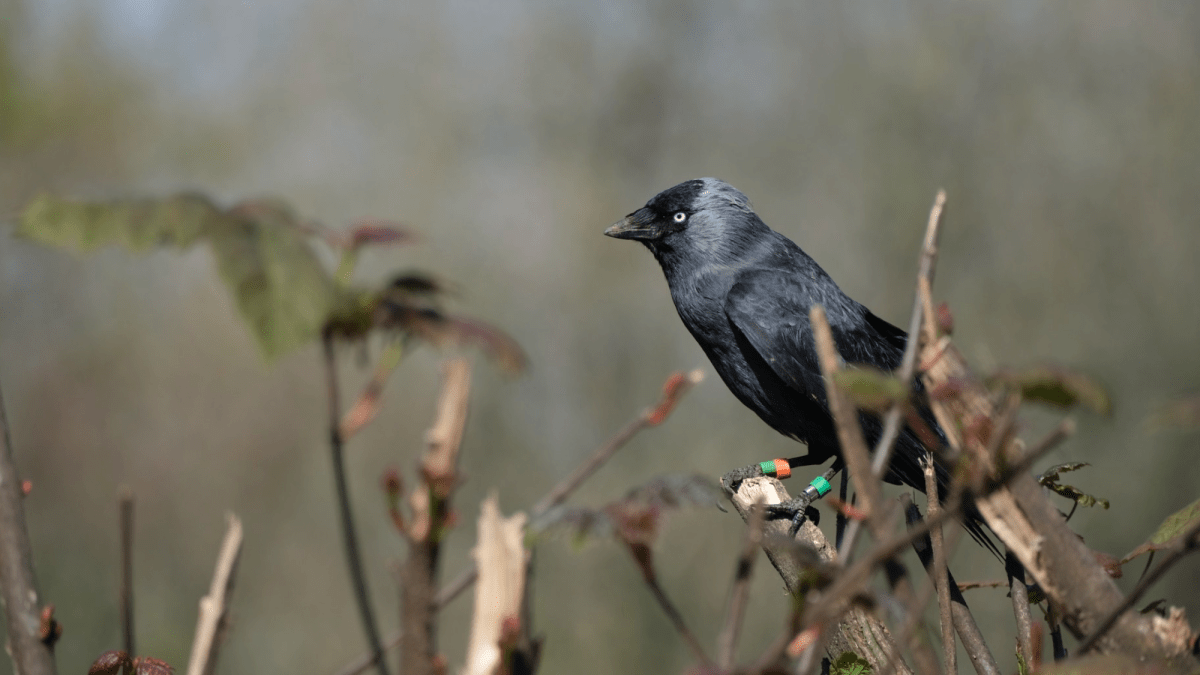
How do chicks learn safe bird calls from ones that mean possible imminent death? According to new research, jackdaw (two species of bird in the genus Coloeus) chicks listen to their elders—but there’s also an evolutionary instinct at play.
In a study recently published in the journal Biology Letters, researchers played the sound of predator calls paired with adult jackdaw alarm calls or the neutral adult jackdaw contact calls to 20 to 30-day-old jackdaw nestlings across 39 wild nests in southwestern England.
They found that listening to predator calls paired with alarm calls taught chicks to be afraid of the predator. The young birds were more vigilant when they heard the call again. On the other hand, the chicks that heard the predator calls paired with the contact calls did not gain this fear.
“Our study shows that nestling jackdaws can learn about dangers they might encounter in the future by listening to adults,” Hannah Broad, lead-author of the study and a researcher at the University of Exeter’s Centre for Ecology and Conservation, said in a statement. “As they nest in cavities, jackdaws are fairly safe as nestlings. However, learning through trial-and-error after leaving the nest can be dangerous – so social learning as a chick could be highly valuable.”
Broad and her colleagues also revealed that the jackdaw chicks didn’t learn to fear a non-predatory birdcall even when they paired it with alarm calls, indicating that the chick’s learning processes have evolved to only apprehend “biologically meaningful” links. This makes it so that the animals don’t use energy reacting to non-dangerous things.
To simulate a common predator, the team used calls from the Eurasian goshawk (Accipiter gentilis). The non-predator calls came from the American golden plover (Pluvialis dominica). Importantly, the chicks hadn’t heard these calls prior to the study, as they were in Cornwall, England, where it is highly improbable to see the Eurasian goshawk as well as the American golden plover.
However, the chick’s response to the goshawk with the alarm calls points to an evolutionary inclination toward learning about birds of prey. The predatory goshawk calls made the chicks around two times as watchful, and the researchers determined vigilance by observing the chicks lifting their heads above their shoulders.
“Learning to associate events that occur together by chance – for example becoming scared of any birdcall heard at the same time as alarm calls – could cause chicks to learn the wrong information,” explained Alex Thornton, a co-author also from the University of Exeter. “The chicks in our study learned to fear goshawk calls due to social learning from adults, but our findings suggest evolutionary processes may tailor what can be socially learnt.”
Because Goshanks are broadening their range in the United Kingdom, jackdaws in Cornwall might experience them in the near future. “As a result of rapidly changing environments, the ranges inhabited by many species are changing,” added Thornton, who co-authored a previous study testing jackdaw loyalty to friends and family. “Learning processes like the one examined in this study might give species a chance to adapt to new threats.”

2025 PopSci Best of What’s New
Environment,Animals,Biology,Birds,Evolution,Science,WildlifeNews#birds #listen #parents #avoid #eaten1773066904

Recent Post



Gallery






Featured Videos