For thousands of years, hunters around the world have employed poison-tipped arrows to assist in taking down prey. For example, the curare plant poisons used by South and Central American hunters paralyzes the respiratory system. Meanwhile, inhabitants of the Kalahari Desert have relied on the toxins harvested from beetle larvae.
Now, paleoarchaeologists say that a new find in South Africa indicates humans have been using poison arrows for even longer than originally thought. Not only that, but the findings explored in a study published today in the journal Science Advances suggest we have harnessed both tools and native ecologies to their advantage longer than we assumed.
“This is the oldest direct evidence that humans used arrow poison,” Marlize Lombard, an archeologist at the University of Johannesburg and study co-author, explained in a statement. “It shows that our ancestors in southern Africa not only invented the bow and arrow much earlier than previously thought, but also understood how to use nature’s chemistry to increase hunting efficiency.”
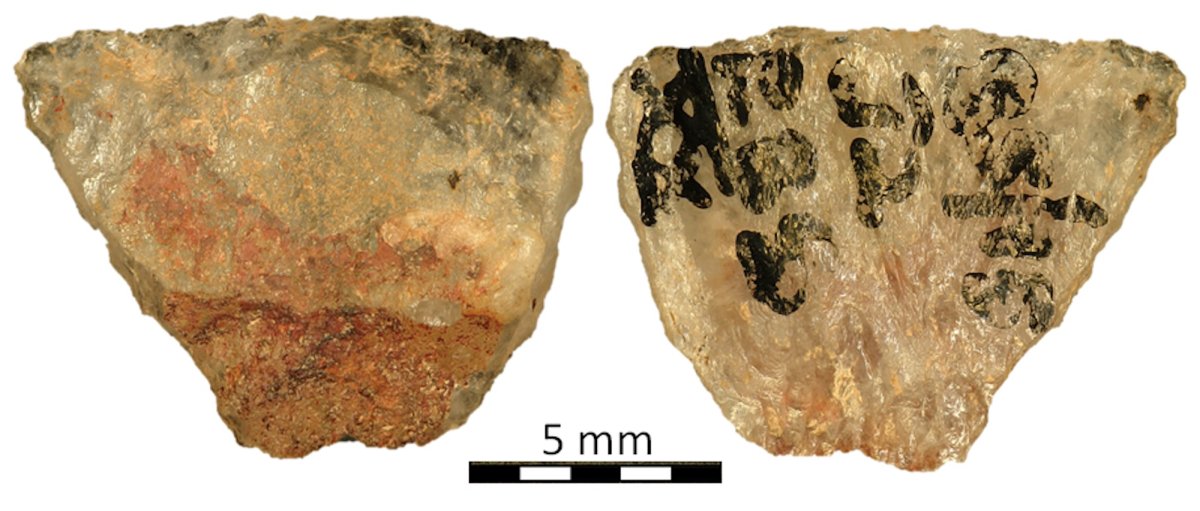
The team found multiple 60,000-year-old quartz arrowheads excavated from the Umhlatuzana Rock Shelter in South Africa’s KwaZulu-Natal Province. The deposit about 300 miles southeast of Johannesburg is famous for its Stone Age artifacts, including evidence of fire-making. Chemical analysis of organic residues on the miniscule quartz weaponry found the presence of buphandrine and epibuphanisine. Both of these compounds are found in a poisonous onion called gifbol (Boophone disticha) that is still used by the region’s Indigenous hunters.
The team then examined more recently made arrowheads housed in Swedish collections. Those specimens, collected by 18th century travellers to South Africa, closely match the organic molecules on the 60,000-year-old discovery.
“Finding traces of the same poison on both prehistoric and historical arrowheads was crucial,” said Stockholm University archaeologist and co-author Sven Isaksson, adding that he found it “fascinating that people had such a deep and long-standing understanding of the use of plants.”
While scientists have long theorized about ancient poison use based on indirect chemical traces, these quartz arrowheads mark the first direct evidence of using poison on arrowheads.
“By carefully studying the chemical structure of the substances and thus drawing conclusions about their properties, we were able to determine that these particular substances are stable enough to survive this long in the ground,” he said.
According to Anders Högberg, a study co-author and archaeologist at Sweden’s Linnaeus University, arrow poison illustrates the levels of planning, artisanry, and logical cognition already exhibited by Stone Age peoples.
“It is a clear sign of advanced thinking in early humans,” he said.

2025 PopSci Outdoor Gift Guide
Science,Archaeology,Environmenthistory,News,plants#Worlds #oldest #poisontipped #arrow #discovered #South #Africa1767812418